Pages

Share This

Deepseek https://www.deepseek.com/./深度求索 DeepSeek | 深度求索

Monday, August 24, 2026

Tabung Haji: A story of mismanagement


For generations of Malaysian Muslims, Tabung Haji has been more than a financial institution. It is a trusted place to save for one of the most important journeys in their life – the pilgrimage to Mecca. — AZLINA ABDULLAH/The Star

NOT all Malaysians will understand the scale of the Tabung Haji scandal as it does not hit their pockets directly.

However, this disturbing scandal is a story of mismanagement and apparent abuses, a failure of fiduciary

It would not be wrong to suggest that even many members of Parliament who read the report would not understand it fully.

The reality, unfortunately, is that the cost of the alleged financial mismanagement of Tabung Haji has to be borne by all Malaysians as a whole – not just Muslims.

The government reportedly executed a financial rescue package exceeding RM10bil for Tabung Haji to restore its financial standing following several controversial issues. duties, poor investments, weak governance and more.

The findings from the recent Royal Commission of Inquiry (RCI) highlighted several malfeasances – intentional and unlawful acts of wrongdoing – from 2014 to 2017, prompting the ongoing anti-corruption investigations and plans to amend the Tabung Haji Act.

To put it simply, a government bail-out had to be carried out to address impaired assets – the drop in the value of a business asset below its recorded book value – and structural deficits.

A structural deficit is a budget shortfall when ongoing spending is higher than regular income.

If the rescue had not been done, Tabung Haji would likely have been forced to adopt a mass sell-off of fund assets, which would have had severe implications.

The key RCI findings exposed alleged severe governance failures, dubious hotel leases abroad, and misleading investment strategies under the previous management.

For generations of Malaysian Muslims, Tabung Haji has been more than a financial institution. It was a trusted place to save for one of the most important journeys in their life: the pilgrimage to Mecca.

This makes the controversies surrounding Tabung Haji more painful and a huge letdown.

The most disturbing part is that the money involved was the savings of ordinary Malaysian Muslims who put aside their hard-earned money, ringgit by ringgit, believing that their savings would be managed responsibly.

Tabung Haji was created on Sept 30, 1973, as the Malayan Muslim Pilgrims Savings Corpo-ration. Founded by the late economist Royal Prof Ungku Abdul Aziz, it was created with the noble purpose of helping Malaysian Muslims to save money for the haj.

It gave Muslims a safe and syariah-compliant way to save for the haj. It also helped make the pilgrimage possible for gene-rations who might otherwise have struggled to afford it.

But an institution built on trust can be badly damaged when those entrusted with managing it forget who the money belongs to.

The lessons from the Tabung Haji saga are therefore much bigger than just accounts and balance sheets.

They are about governance, accountability, and above all, they are about what happens when political influence, poor management, and questionable decisions are allowed to weaken an institution meant to serve the people.

The horror is not simply that money can be lost. Money can be recovered, institutions can be restructured, policies can be changed – but trust is much harder to rebuild.

Ordinary depositors who now read about questionable investments, inflated valuations, transactions involving connected parties, or decisions that appear to benefit others, must ask one simple question: Who was looking after our money?

That question deserves a straight answer. Not political statements meant to divert from the main issue. Not another spin on race and religion to get out of a tight spot.

Tabung Haji cannot be treated as a political cash cow or a convenient source of influence.

Its board and management must be chosen for competence, integrity, and independence. There must be proper checks and balances, professional investment decisions, and transparent reporting.

When will we ever learn that politicians – many of whom do not even have corporate and financial competence – have no business running a savings corporation involving billions of ringgit?

A look at the board of directors of the past management will reveal that some of its members were picked based merely on their political party standing.

There is also a wider lesson here for Malaysia.

We have too often allowed institutions to become vulnerable because we assume that those in charge will always do the right thing.

That is not good enough and certainly not true. Good governance requires building systems that prevent abuse, detect wrongdoing early, and ensure that no one is too powerful to be questioned.

Tabung Haji’s experience should therefore be remembered not merely as another financial scandal or political controversy. It should be remembered as a warning.

When an institution holds the life savings of ordinary people, there can be no room for complacency, cronyism, or political interference.

The depositors of Tabung Haji deserve nothing less than the highest standards of stewardship.

The money of Malaysian Muslim depositors was entrusted to Tabung Haji. So was their trust, and that trust should never again be treated so callously.

Let’s not forget that the money of other Malaysians, regardless of race and faith, had to be used to bail out Tabung Haji.

We have politicians who claim that the word “sakau”, which means to steal, to rob, to pilfer or to embezzle, was never used in the RCI report. Of course not.

Sakau is Malay slang or street language for stealing or embezzling, but in another connotation, is also used for drug craving and addiction.

Certainly, we do not expect the esteemed members of the RCI to use that word in their report.

Ahead of National Day, the actions of the culprits can best be described as a most traitorous act to the country and Malaysians.

Wong Chun Wai

Wong Chun Wai

Wong Chun Wai began his career as a journalist in Penang and served Star Media Group for nearly four decades in various capacities and roles. He was group editorial and corporate affairs adviser to the group, after having served as group managing director/chief executive officer. "On The Beat" debuted on Feb 23, 1997. Chun Wai has penned the column weekly without a break, except for occasional press holidays when the paper was not published. In May 2011, a compilation of selected articles of On The Beat was published as a book and launched in conjunction with his 50th birthday. Chun Wai also comments on current issues in The Star. He is now chairman of national news agency Bernama.

Friday, August 21, 2026

Google’s Malaysian play


KUALA LUMPUR: A single job created directly inside Google’s upcoming US$2bil (RM9.4bil) data centre (DC) in Selangor will generate nine additional jobs across the local economy.

That powerful one-to-nine employment multiplier lies at the heart of the tech giant’s first Malaysian facility and cloud region in Elmina Business Park.

The facility, Google’s second in South-East Asia after Singapore, aims to debunk the widespread industry myth that hyperscale DCs are empty, low-employment “ghost boxes” once construction wraps up.

Beyond the thousands of short-term construction roles, Google aims to hire hundreds of high-value, permanent engineers, technicians, and specialists directly inside the facility, said Ken Siah, principal for global infrastructure market development at Google Asia Pacific, in an exclusive interview with StarBiz.

Google’s DCs, he explained, drive extensive local contracts, from server rack supply chains and specialised engineering consultancies to on-site dining services and green energy projects.

Siah also sought to dispel the misconception that operational DCs require minimal human oversight, noting that managing Google’s proprietary “all-product area” hyperscale infrastructure requires round-the-clock, highly specialised technical talent.

These jobs go beyond information technology maintenance, Siah said, and include DC technicians comprising highly skilled engineers managing server operations, hardware deployments, software coding and live troubleshooting; network engineers responsible for connectivity, ensuring global ultra-low latency and network reliability for millions of users; mechanical and electrical engineers as operational leads maintaining continuous 24/7 power distribution, backup systems and complex thermal cooling loops; and environmental and compliance leads specialising in water management, energy strategy, community affairs and safety compliance.

“It’s not just about the hardware. Engineering inside a hyperscale facility is an entire organisation, so these are jobs that are created specifically because of the contracts that the Google DC is driving,” he said.


Ken Siah, Principal, Global Infrastructure, Asia Pacific, Google. — IZZRAFIQ ALIAS/The Star 
 Enggineering inside a hhperscale facilities is an entire organisation, so thre are jobs that are created  spicifically because of the constracts that the Google DC is driving.

As Google sources hardware components and maintenance services locally wherever possible, Malaysia’s mature semiconductor and electronics manufacturing ecosystem stands to capture significant commercial value, he pointed out.

While Malaysia’s unemployment rate remained low at 2.9% for the first five months of 2026, high-skilled workers accounted for the largest share of those affected during this period, making up more than half of retrenchments from 2021 to 2025.

“There is a very educated and talented workforce here. We’ve really had no issue finding and hiring local talent,” Siah said.

To ensure local talent fills these high- value positions, he said Google is investing across three human capital tracks: on-the-job upskilling, comprising mandatory operational and safety training for all employees and contractors; tertiary skilling programmes comprising industry-aligned courses in artificial intelligence (AI) and DC operations; and early science, technology, engineering and mathematics partnerships, providing foundational training through initiatives such as Arus Academy KL focused on future skills development.

Rapid DC expansion has also sparked public debate over energy grid stability and municipal water consumption.

Siah outlined Google’s self-funded operational model built on 20 years of global infrastructure development.

For example, rather than driving up electricity costs for local households, Google finances its own infrastructure expansion.

“Think of a power grid like a toll highway with fixed maintenance costs,” Siah explained.

“If very few cars drive on it, the toll per car is high. But when a major logistics fleet commits to using that highway, the overall cost burden per user drops.

“If there is insufficient power in an area, or if we are going to be taking power away from a community, we will either find ways to develop more power, or we will not go there,” Siah said.

In other words, Google would not pass any infrastructure costs on to local ratepayers.

He added that Google is one of the few hyperscalers that publicly reports its operational power usage effectiveness (PUE) on a quarterly basis across all its campuses. PUE is the primary industry metric used to measure the energy efficiency of a DC.

While the global industry average hovers around 1.52 to 1.56, Google’s global fleet operates at 1.08 to 1.09. Even in hot, humid tropical climates like Singapore, Google maintains a PUE of 1.13.

“So, it’s precisely because we have efficient design, good chips and good operational culture that allows us to achieve this, and we are very confident we can do the same in Malaysia,” he said.

As of early 2026, DCs in Malaysia consume an actual average of 28.68 million litres of water per day, according to the National Water Services Commission.

Estimates project total nationwide water consumption by tech hubs to surge past 37 billion litres annually, climbing steeply through 2030.

The question is how Google assesses the risk of water scarcity at a particular location.

“If a community faces water scarcity, we simply will not use water cooling methods. We will rely on other methods, whether that is air cooling or newer chips with more advanced liquid-cooling methods,” Siah said.

DCs use water and liquid-cooling systems to manage intense heat loads from high-density servers and AI workloads. Traditional facility-level systems use chilled-water loops and evaporative cooling towers, while modern rack-level designs deploy direct-to-chip or immersion cooling to boost thermal-transfer efficiency

Where water is used, closed-loop systems continually recycle it. On top of that, Google has committed to a global goal of replenishing 120% of the freshwater its DCs consume.

In an industry where tech multinationals routinely demand tax holidays before entering a market, Google’s approach in Malaysia breaks from the norm: the company says it is not seeking local tax breaks.

“We believe in being a good corporate citizen,” said Siah. “We pay all relevant taxes, which go straight to the Malaysian government to support public services.”

By AIDA AHMAD

Thursday, August 13, 2026

RCI revealsTabung Haji billions lost through illegal creative accounting


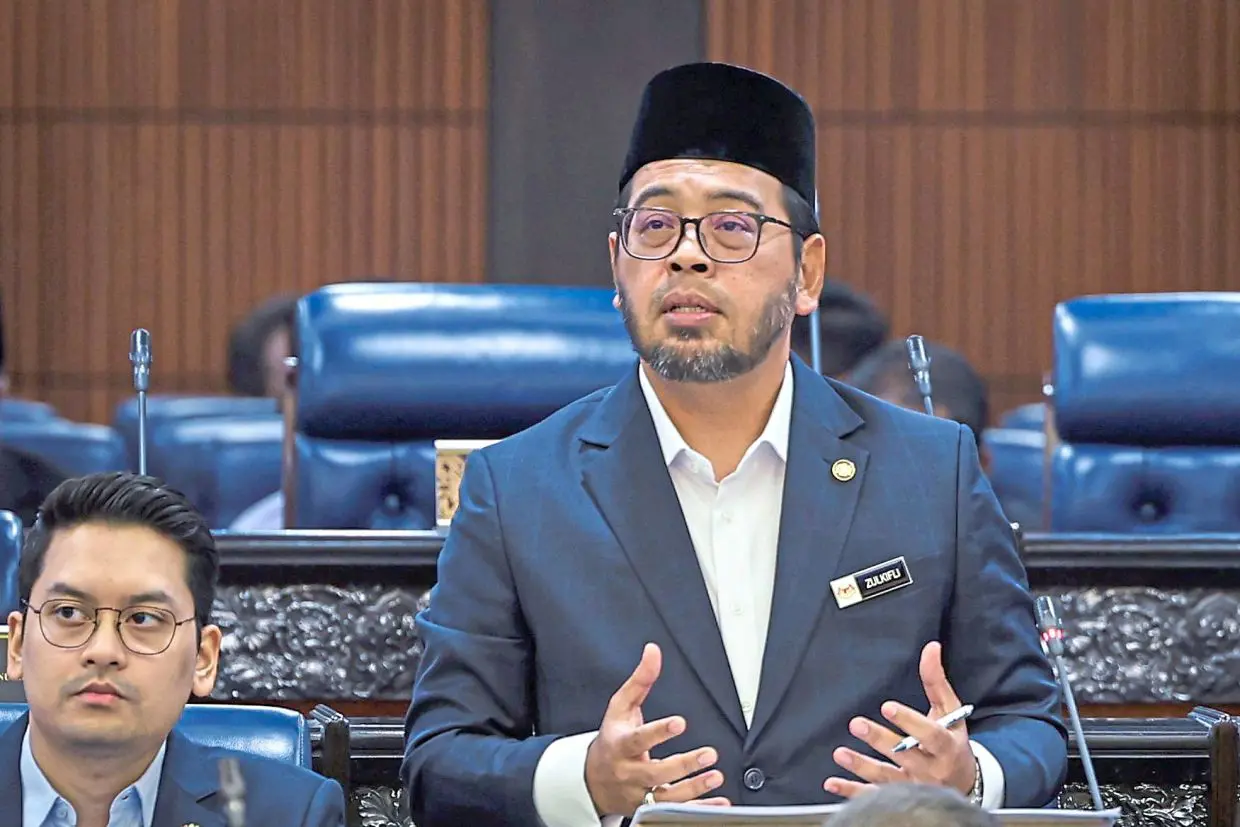
Revelations: Zulkifli speaking during the special sitting on the RCI into TH, in Parliament. — Bernama

KUALA LUMPUR: Lembaga Tabung Haji (TH) entered into high-risk investments, which resulted in billions in losses, because it faced pressure to declare high dividends.

Also identified were breaches of accounting ­standards and financial reporting that did not reflect the actual ­position of the board.

These were among the issues flagged by the Royal Commission of Inquiry (RCI) into the ­institution, Minister in the Prime Minister’s Department (Religious Affairs) Dr Zulkifli Hasan said.

He said the RCI report ­identified 14 problematic investments.

Among them were Putrajaya Perdana, Al-Rawda, PT TH Indo Plantations, Trurich and FGV, which involved the interests of certain parties.

“For example, in 2015, 2016 and 2017, TH leased four hotels in Mecca and Madinah and paid approximately RM1.55bil upfront to Al-Rawda for leases ranging from 10 to 18 years. This was an unusual and highly ‘abnormal’ transaction,” he said.

Al-Rawda was appointed as the operator of all four hotels and in exchange, TH was given promissory notes personally guaranteed by the owner of Al-Rawda.

“Since March 2019, Al-Rawda has failed to pay the rental income, and TH initiated enforcement proceedings in Saudi Arabia.

“Arbitration proceedings commenced by Al-Rawda against TH were ultimately resolved through a final award dated April 16, 2023 in favour of TH. Al-Rawda was ordered to pay SAR899mil (RM982mil)

The RCI flagged the listing of FGV Holdings, which although raised RM10bil during its initial public offering (IPO), had resulted in loses amounting to more than RM1bil for TH when its share prices plunged.

Investments related to 1Malaysia Development Bhd (1MDB), including its link to Putrajaya Perdana and the ­purchase of land in TRX when the CEO of Tabung Haji was also ­sitting on the board of 1MDB, were also flagged.

Zulkifli said the RCI found that profit distributions made before 2018 did not reflect TH’s actual financial position and were inconsistent with the requirements of the Tabung Haji Act, which requires assets to exceed liabilities.

He added the RCI found that financial statements were manipulated through creative accounting, breaches of Malaysian Financial Reporting Standards (MFRS), and repeated changes to impairment policies.

He said the impairment was only recognised when the ­market value of the assets fell by 70% from the original investment cost.

“This was subsequently changed to 85% and then to 90% within a single day during the 2017 financial year.

“For example, for an original share investment of RM1,000, impairment would only be recognised when the market value of the shares fell to RM100.

“In reality, if the investment had been sold in the market at that point, TH would have recovered only RM100 rather than RM1,000 as stated in the financial statements,” he said.

This, he said, allowed TH to show a profit for that year when it should have shown a loss, ­adding that this was also approved by the minister in charge at the time.

Asset values were also presented using the Realisable Asset Value method outside the audited financial statements, despite the method not complying with accounting standards, so that it would appear that TH’s assets exceeded their liabilities. All of which was confirmed in an audit report in 2018.

The RCI also highlighted financial reporting practices, whereby certain losses were not properly recognised in the income statement and balance sheet, resulting in “falsified profits”.

He said that had TH applied the MFRS standards, it would have recorded a net loss of RM1.4bil instead of a profit of RM3.4bil for 2017.

Related:

Tabung Haji:A story of mis­man­age­ment


2 days agoFinance Minister II Datuk Seri Amir Hamzah Azizan said the 14 investments identified by the RCI had resulted in estimated losses of nearly RM13 ...Read more
1 day agoAmir Hamzah said all 14 troubled investments identified by the RCI collectively resulted in RM13 billion in losses. “This cannot be ...Read more
In this episode, we break down the massive Tabung Haji scandal following the declassification of the Royal Commission of Inquiry (RCI) report.
Missing: MINISTER:REVEALS
2 days agoOverall, Amir said the losses comprised RM10.2 billion absorbed by the government through the 2018 rescue and restructuring of TH's troubled ...Read more
Missing: REVEALS ‎| Show results with: REVEALS
Minister: RCI reveals billions lost by TH THESTAR.COM.MY “set a standard” on how to approach government-linked companies (GLCs), RM31.5 billion ...
2 days agoUnder the recovery and restructuring plan, RM10 billion was addressed through the 2018 Recovery Plan, while the remaining RM2.6 billion was ...Read more
The RCI exposed 14 major problematic investments with losses estimated at nearly RM13 billion. ... minister Zulkifli Hasan. He said the ...Read more