Pages

Share This

Deepseek https://www.deepseek.com/./深度求索 DeepSeek | 深度求索
Showing posts with label Bursa Malaysia. Show all posts

Friday, March 6, 2026

RM79.6bil windfall for EPF members


'CLICK TO ENLARGE'

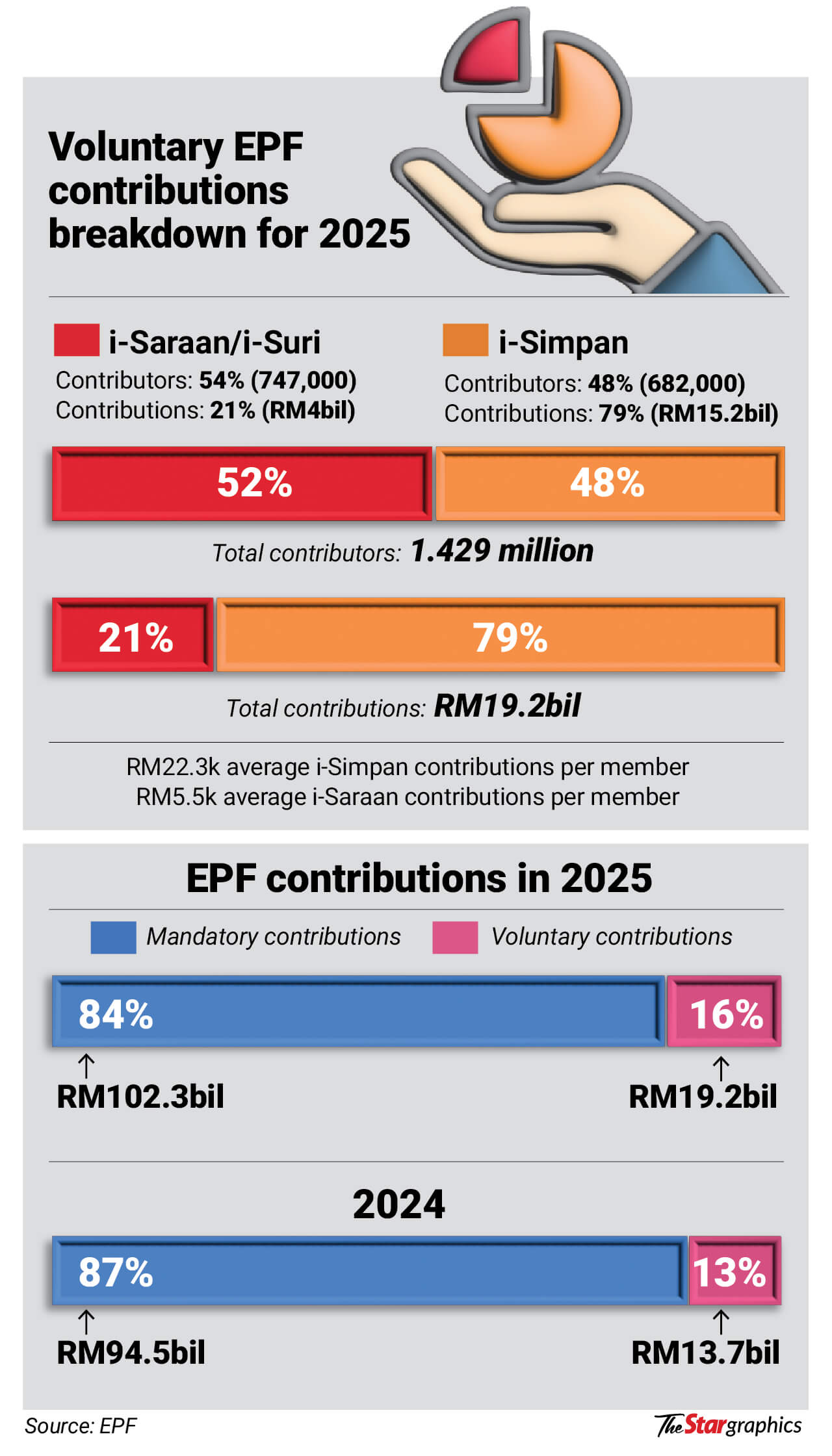
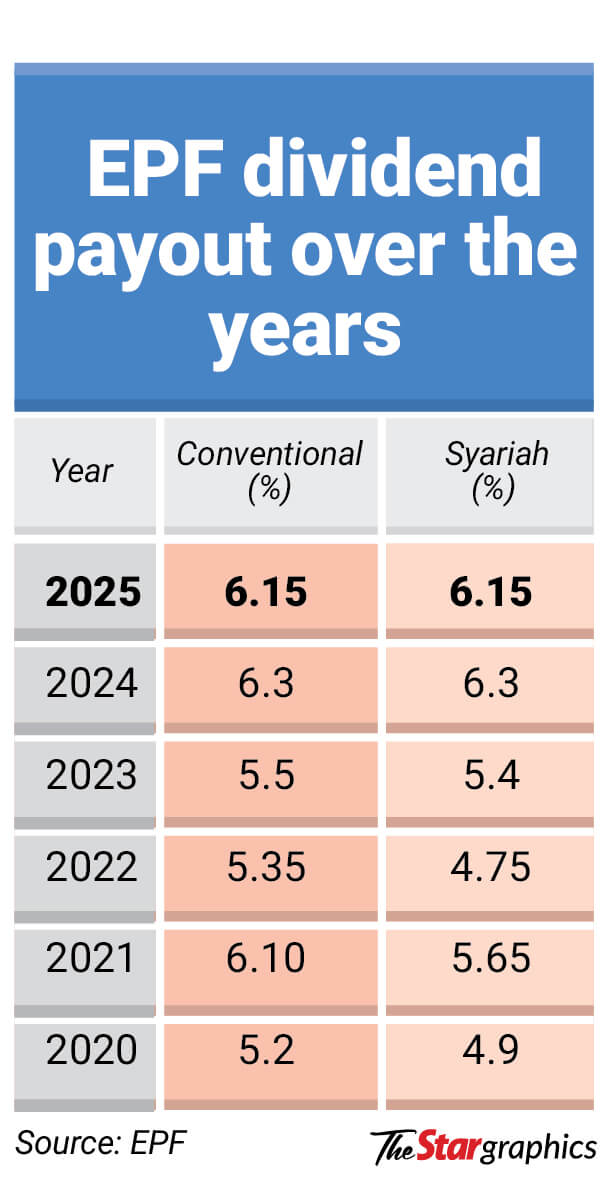
SHAH ALAM: The Employees Provident Fund (EPF) has declared a lower dividend for 2025 at 6.15% for both conventional and syariah accounts.

The total dividend payout for 2025 is RM79.6bil, whereby RM67.1bil is for conventional accounts and RM12.5bil for syariah accounts.

For 2024, the EPF declared a dividend rate of 6.3% for conventional savings with a total payout of RM63.05bil, as well as a 6.3% dividend for syariah savings, with a payout amounting to RM10.19bil.

EPF chief executive officer Ahmad Zulqarnain Onn attributed the lower payment to the slower growth of Bursa Malaysia’s Kuala Lumpur Composite Index (KLCI), which grew at 2.3% last year compared to about 12.9% in 2024.

Secondly, he said, assets denominated in the US dollar were also impacted due to the strength of the local currency.

The strengthening of the ringgit against the US dollar “impacted the value in ringgit of our income from dollar assets”, he said during the retirement fund’s dividend announcement yesterday.

“The ringgit does impact our international holdings and it was one of the best-performing currencies in the world, gaining 10.2%.”

The EPF recorded a total investment income of RM79.2bil for 2025, up from the RM74.46bil reported in 2024.

Investment assets grew to RM1.409 trillion, which is a 12.8% increase from the RM1.25 trillion recorded in the previous year, driven by portfolio income and net contributions of RM66.5bil.
'CLICK TO ENLARGE'
'CLICK TO ENLARGE'

The EPF recorded a total distributable income of RM82.7bil for 2025, up 9.5% from RM75.5bil in 2024.

Domestic investments continued to provide steady income, with 61.7% of the RM1.409 trillion worth of assets invested domestically. They generated investment income of RM39.3bil and accounting for 49.6% of total investment income.

Global investments, representing 38.3% of the portfolio, generated RM39.9bil and accounted for 50.4% of total investment income.

Ahmad Zulqarnain said the outlook for 2026 is moderate in the face of uncertainties.

“We believe economic growth will continue to be within expectations for most parts of the world, including continued growth in Malaysia,” he noted.

“Malaysia delivered 5.2% in 2025; the estimates are 4.3% for this year. But as we know, we also live in a world of great uncertainties, more so today than it has been for many decades.

“The risks are around trade policies, geopolitics, the path of inflation and, therefore, monetary policy and interest rates, increasing public debt, and the impact of artificial intelligence, which will create new winners and new losers. We believe Malaysia is in a good place,” he added.

“The top three themes for Malaysia that we believe will be persistent for the next decade are healthcare as we age as a nation, artificial intelligence, data and digitalisation as our personal and work lives become more and more digital, and energy as the world transitions to green energy.”
'CLICK TO ENLARGE'
'CLICK TO ENLARGE'

Meanwhile, the EPF will introduce the i-Legasi scheme, enabling contributors aged 55 and above to pass down their retirement savings to their children.

This scheme allows contributors to transfer their savings “intergenerationally” to their children. However, this applies only to members who are already eligible to withdraw their savings.

Ahmad Zulqarnain also said EPF dividends must be credited into the correct account as provided for under the law.

“If the savings are in Account 1 or Account 2, the dividends must be credited into those accounts,” he said.

“We cannot take dividends from other accounts and transfer them,” he said in reference to Arau MP Datuk Seri Shahidan Kassim’s suggestion that the dividends be channelled to the flexible account.

Silver EPF lining

6.15% dividend for conventional, syariah accounts

'CLICK TO ENLARGE'

SHAH ALAM: The Employees Provident Fund (EPF) has declared a lower dividend for 2025 at 6.15% for both conventional and syariah accounts.

The total dividend payout for 2025 is RM79.6bil, whereby RM67.1bil is for conventional accounts and RM12.5bil for syariah accounts.

For 2024, the EPF declared a dividend rate of 6.3% for conventional savings with a total payout of RM63.05bil, as well as a 6.3% dividend for syariah savings, with a payout amounting to RM10.19bil.

EPF chief executive officer Ahmad Zulqarnain Onn attributed the lower payment to the slower growth of Bursa Malaysia’s Kuala Lumpur Composite Index (KLCI), which grew at 2.3% last year compared to about 12.9% in 2024.

Secondly, he said, assets denominated in the US dollar were also impacted due to the strength of the local currency.

The strengthening of the ringgit against the US dollar “impacted the value in ringgit of our income from dollar assets”, he said during the retirement fund’s dividend announcement yesterday.

“The ringgit does impact our international holdings and it was one of the best-performing currencies in the world, gaining 10.2%.”

The EPF recorded a total investment income of RM79.2bil for 2025, up from the RM74.46bil reported in 2024.

Investment assets grew to RM1.409 trillion, which is a 12.8% increase from the RM1.25 trillion recorded in the previous year, driven by portfolio income and net contributions of RM66.5bil.

'CLICK TO ENLARGE'
'CLICK TO ENLARGE'

The EPF recorded a total distributable income of RM82.7bil for 2025, up 9.5% from RM75.5bil in 2024.

Domestic investments continued to provide steady income, with 61.7% of the RM1.409 trillion worth of assets invested domestically. They generated investment income of RM39.3bil and accounting for 49.6% of total investment income.

Global investments, representing 38.3% of the portfolio, generated RM39.9bil and accounted for 50.4% of total investment income.

Ahmad Zulqarnain said the outlook for 2026 is moderate in the face of uncertainties.

“We believe economic growth will continue to be within expectations for most parts of the world, including continued growth in Malaysia,” he noted.

“Malaysia delivered 5.2% in 2025; the estimates are 4.3% for this year. But as we know, we also live in a world of great uncertainties, more so today than it has been for many decades.

“The risks are around trade policies, geopolitics, the path of inflation and, therefore, monetary policy and interest rates, increasing public debt, and the impact of artificial intelligence, which will create new winners and new losers. We believe Malaysia is in a good place,” he added.

“The top three themes for Malaysia that we believe will be persistent for the next decade are healthcare as we age as a nation, artificial intelligence, data and digitalisation as our personal and work lives become more and more digital, and energy as the world transitions to green energy.”

'CLICK TO ENLARGE'
'CLICK TO ENLARGE'

Meanwhile, the EPF will introduce the i-Legasi scheme, enabling contributors aged 55 and above to pass down their retirement savings to their children.

This scheme allows contributors to transfer their savings “intergenerationally” to their children. However, this applies only to members who are already eligible to withdraw their savings.

Ahmad Zulqarnain also said EPF dividends must be credited into the correct account as provided for under the law.

“If the savings are in Account 1 or Account 2, the dividends must be credited into those accounts,” he said.

“We cannot take dividends from other accounts and transfer them,” he said in reference to Arau MP Datuk Seri Shahidan Kassim’s suggestion that the dividends be channelled to the flexible account.

Silver EPF lining

6.15% dividend for conventional, syariah accounts

 The good news is 41% of contributors have met the RM240,000 minimum savings, and parents can now pass down their retirement funds to their ...Read more

Steady and reassuring' ... Although the dividend is slightly lower than last year's 6.3%, she described the rate as “steady and reassuring”.Read more


ration-color: initial;">
 The good news is 41% of contributors have met the RM240,000 minimum savings, and parents can now pass down their retirement funds to their ...Read more

Thursday, March 16, 2023

Oppstar soars 225% on ACE Market debut, makes sterling debut on ACE Market

From left: Oppstar chief financial officer Chin Fung Wei, independent non-executive director Datuk Mohd Sofi Osman, independent non-executive chairman Datuk Siti Hamisah Tapsir, executive director and CEO Ng Meng Thai, executive director and chief technology officer Cheah Hun Wah, chief operating officer Tan Chun Chiat, independent non-executive director Datuk Margaret Yeo and independent non-executive director Foong Pak Chee 

Oppstar soars 225% on ACE Market debut


KUALA LUMPUR: Oppstar Bhd made its debut on the ACE Market of Bursa Malaysia at RM2.05 a share, a 225.4% premium over the issue price of 63 sen a share.

The stock was the most actively traded with 19.26 million shares exchanging hands.

The integrated circuit design service provider successfully raised RM104.25mil from the initial public offering exercise via the issuance of 165.48 million new ordinary shares.

Oppstar will utilise RM50mil to expand its workforce and RM25.00mil for the establishment of new offices both locally and regionally.

Meanwhile, another RM12mil will go towards research and development expenditure along with RM12.65mil for working capital.

The remaining RM4.6mil will be allocated for its listing related expenses.

“Our vision for the company is simple and clear and it is to show the global players that Malaysia is not only known for its back-end semiconductor value chain, but also has the capability to go into front-end semiconductor IC design.

"I am proud to say that we now serve clients in countries such as China, Malaysia, Japan, Singapore, as well as the USA.

"As we gradually progress, we continually ask ourselves what we can do to expand our business and continue to build up Malaysia’s profile in the front-end semiconductor space. This was where the rationale to go for a listing came about leading up to this today," said Oppstar executive director and CEO Ng Meng Thai said in a statement. 

Source link


Oppstar makes sterling debut on ACE Market


PETALING JAYA: Oppstar Bhd will focus on building its human resource capital post-listing, as the technology sector is set to grow from the opportunities presented by 5G, artificial intelligence and the Internet of Things.

The integrated circuit design service provider’s chief executive officer Ng Meng Thai said the bulk of the proceeds raised from Oppstar’s listing on the ACE Market of Bursa Malaysia yesterday would be used for the workforce expansion.

“At the moment we have 220 engineers and we have plans to increase that number to 500 in the next three years. With an enlarged workforce, we also hope to grow our revenue and profitability accordingly,” he said after the company’s listing yesterday.

The group is collaborating with various universities in the country to secure future design engineers.

“We started a programme in 2020 where we hire third-year university students for three months. They work part time for 20 hours a week and are paid RM1,500 a month. Upon graduating, they are required to work for us for a year. This is how we build our talent pool.

“When it comes to business, the multinational corporations (MNCs) are our customers. However these MNCs become our competitors when it comes to hiring. This is why other than fundraising, our objective in carrying out the listing exercise is also about hiring and retention,” said Ng.

Oppstar raised RM104.3mil from the public issue of 165.48 million new shares. The company made its debut in the market opening at RM2.05 per share, or a RM1.42 premium above the offer price of 63 sen per share.

The stock closed its maiden trading day up 285.7% or RM1.80 higher at RM2.43 a share. The share price hit a high of RM2.95 and a low of RM2 in intraday trade. Oppstar’s listing did not have an offer for sale of shares from its shareholders.

Oppstar chief financial officer Chin Fung Wei said the group intends to implement a long-term incentive plan of up to 15% of the total number of issued shares of the company for its employees.

“Prior to our initial public offering (IPO), we already had more than 20 shareholders. In fact, every one of our employees, except for those that came on board after the IPO’s closing date, is a shareholder of the company. This is one of our remuneration methods for our employees, apart from their monthly salary,” he said.

Ng added the group’s listing showed Malaysia was not only known for its back-end semiconductor value chain, but also had the capabilities to go into front-end semiconductor integrated circuit design.

“We serve clients in countries such as China, Malaysia, Japan, Singapore, as well as the US. Our expansion plans will enable us to groom future talent and grow our geographical presence which will progressively help strengthen Malaysia’s front-end semiconductor ecosystem in line with our vision,” he said.

The group plans to payout at least 25% of its annual earnings as dividends. AmInvestment Research said the US-China trade war bodes well for Oppstar because China is compelled to develop its own semiconductor capabilities. 

Source link

Related posts:

IC designer Oppstar focuses on talent, IPO offers good value for mony

  Oppstar is one the few Malaysian companies in the front-end of the semiconductor industry, offering a full spectrum of IC design services...

  Related news:

KLSE Screener
https://www.klsescreener.com › news › view › oppstar...
12 hours agoOppstar makes sterling debut on ACE Market. TheStar Thu, Mar 16, 2023 12:00am - 8 hours View Original. From left: Oppstar chief financial ..
 

ACE-Market listed Oppstar debuts at RM2.05, 225% premium ...

The Edge Markets
https://www.theedgemarkets.com › node
1 day agoACE-Market listed Oppstar debuts at RM2.05, 225% premium against IPO price of 63 sen.
 

ACE Market-bound Oppstar's IPO oversubscribed by 77 times

Daily Express Malaysia
https://www.dailyexpress.com.my › news › ace-market...
7 Mar 2023PETALING JAYA: Oppstar Bhd, which is en route to a listing on Bursa Malaysia's ACE Market on March 15, saw its initial public offering (IPO) ...


Oppstar Berhad KLSE:OPPSTAR Stock Report - Simply Wall St


Saturday, March 3, 2018

Tailwinds and headwinds into 2018


2017 was a year of smooth tailwinds, even though everyone was mesmerized by the Trump reality show. Heading into 2018, one issue on everyone’s minds is whether headwinds will finally catch up when the tide goes out.

ALL markets function on a heady mix between greed and fear. When the markets are bullish, the investors know no fear and regulators think they walk on water. When fear grips the markets, and everyone is staring at the abyss, all eyes are on the central banks whether they will come and rescue the markets.

Last year was one of smooth tailwinds, even though everyone was mesmerised by the Trump reality show.

Heading into 2018, one issue on everyone’s minds is whether headwinds will finally catch up when the tide goes out.

Last week at a Tokyo conference, Fed vice chairman Randy Quarles was visibly confident about the US economy. Real gross domestic product (GDP) growth through the final three quarters of 2017 averaged almost 3%, faster than the 2% average annual pace recorded over the previous eight years.

The European recovery, barring Brexit, looked just as rosy. Eurozone growth has stepped up to 2.7% in 2017, with inflation at around 1.2% and unemployment down to 8.7%, the lowest level recorded in the eurozone since January 2009.

In Asia, 2017 Chinese GDP grew by 6.9% to 59.7 trillion yuan or US$9.4 trillion, just under half the size of the United States. With per capita GDP reaching US$8,836, China is expected to reach advanced country status by 2022.

Meanwhile, the Indian economy has recovered from its stumble last year and may overtake China in growth speed in 2018, with an estimated rate of 7.4%.

The tailwinds behind the growth recovery seem so strong that the IMF’s January world economic outlook for 2018 sees growth firming up across the board. The IMF’s headline outlook is “brighter prospects, optimistic markets and challenges ahead.”

Expressing official prudence, “risks to the global growth forecast appear broadly balanced in the near term, but remain skewed to the downside over the medium term.”

Having climbed almost without pause in most of 2017 to January 2018, the financial markets skidded in the first week of February. On Feb 5, the Dow plunged 1,175 points, the biggest point drop in history. The boom in 2017 was too good to be true and fear came back with the re-appearance of volatility.

Amazingly, the drop of around 11% from the Dow peak of 26,616 on Jan 26 to 23,600 on Feb 12 was followed by a rebound of 9% in the last fortnight.

Global stock market indices became highly co-related as losses in Wall Street resulted in profit taking in other markets which then also reacted in the same direction.

Will headwinds disrupt the market this year or will there be tailwinds like the economic forecasts are suggesting?

What makes the reading for 2018 difficult is that the current buoyant stock market (and weak bond market) is driven less by the real economy, but by the current loose monetary policy of the leading central banks.

With clearer signs of firming real recovery, central banks are beginning to hint at removing their decade long stimulus by cutting back their balance sheet expansion and suggesting that interest rate hikes are in the books.

The projected three hikes for Fed interest rates in 2018 augur negatively on stock markets and worse on bond markets.

The broad central bank readout is as follows.

The Bank of England and the Fed are leaning on the hawkish side, the European Central Bank (ECB) is divided and the Bank of Japan will still be on the quantitative easing stance.

In his first testimony to Congress, the new Fed chairman Jay Powell was interpreted as hawkish. In his words, “In gauging the appropriate path for monetary policy over the next few years, the FOMC will continue to strike a balance between avoiding an overheated economy and bringing PCE price inflation to 2% on a sustained basis. In the FOMC’s view, further gradual increases in the federal funds rate will best promote attainment of both of our objectives.”

What is more interesting is the divided stance facing the ECB. In his latest statement to the European Parliament, ECB president Mario Draghi reaffirmed that the eurozone economy is expanding robustly. Because inflation appears subdued, although wage growth has picked up, he argued that “patience and persistence with respect to monetary policy is still needed for inflation to sustainably return to levels of below, or close to, 2%.”

In an unusually critical and almost unprecedented article published last month by Project Syndicate, the former ECB Board member and deputy president of the Bundesbank Jurgen Stark called the ECB “irresponsible”, suggesting that its refusal to normalise policy faster is drastically increasing the risks to financial stability. In short, the bigger partners in Europe think tightening is the right way to go.

If both central banks begin to reverse their loose monetary policy and unwind their balance sheets, liquidity will become tighter and interest rates will rise.

Financial markets have therefore good reason to be nervous on central bank policy risks.

There is ample experience of mishandling of policy reversals.

After the taper tantrum of 2014, when markets fell on the fear of the Fed unwinding too early and too fast, central bankers are particularly aware that they are walking a delicate tightrope.

If they reverse too fast, markets will fall and they will be blamed. If they reverse too slow, the economy could overheat and inflation will return with a vengeance, subjecting them to more blame.

In the meantime, trillions of liquid funds are waiting in the sidelines itching to bet on market recovery at the next market dip. But this time around, it is not the market’s invisible hand, but visible central bank policies that may pull the trigger.

Man-made policies will always be subject to fickle politics. The raw fear is that once the market drops, it won’t stop unless the central banks bail everyone out again. This means that central bankers are still caught in their own liquidity trap. Blamed if you do tighten, and damned by inflation if you don’t.

There are no clear tailwinds or headwinds in 2018 – only lots of uncertain turbulence and murky central bank tea leaves. Fear and greed will dominate the markets in the days ahead.

 
Andrew Sheng is distinguished fellow, Asia Global Institute at the University of Hong Kong.


Related Links

Market weighed by external pressures | KLSE Screener


US Fed's Powell nods to stronger economy, backs ... - KLSE Screener


Tailwinds and headwinds into 2018

 2017 was a year of smooth tailwinds, even though everyone was mesmerized by the Trump reality show. Heading into 2018, one issue on everyone’s minds is whether headwinds will finally catch up when the tide goes out.

ALL markets function on a heady mix between greed and fear. When the markets are bullish, the investors know no fear and regulators think they walk on water. When fear grips the markets, and everyone is staring at the abyss, all eyes are on the central banks whether they will come and rescue the markets.

Last year was one of smooth tailwinds, even though everyone was mesmerised by the Trump reality show.

Heading into 2018, one issue on everyone’s minds is whether headwinds will finally catch up when the tide goes out.

Last week at a Tokyo conference, Fed vice chairman Randy Quarles was visibly confident about the US economy. Real gross domestic product (GDP) growth through the final three quarters of 2017 averaged almost 3%, faster than the 2% average annual pace recorded over the previous eight years.

The European recovery, barring Brexit, looked just as rosy. Eurozone growth has stepped up to 2.7% in 2017, with inflation at around 1.2% and unemployment down to 8.7%, the lowest level recorded in the eurozone since January 2009.

In Asia, 2017 Chinese GDP grew by 6.9% to 59.7 trillion yuan or US$9.4 trillion, just under half the size of the United States. With per capita GDP reaching US$8,836, China is expected to reach advanced country status by 2022.

Meanwhile, the Indian economy has recovered from its stumble last year and may overtake China in growth speed in 2018, with an estimated rate of 7.4%.

The tailwinds behind the growth recovery seem so strong that the IMF’s January world economic outlook for 2018 sees growth firming up across the board. The IMF’s headline outlook is “brighter prospects, optimistic markets and challenges ahead.”

Expressing official prudence, “risks to the global growth forecast appear broadly balanced in the near term, but remain skewed to the downside over the medium term.”

Having climbed almost without pause in most of 2017 to January 2018, the financial markets skidded in the first week of February. On Feb 5, the Dow plunged 1,175 points, the biggest point drop in history. The boom in 2017 was too good to be true and fear came back with the re-appearance of volatility.

Amazingly, the drop of around 11% from the Dow peak of 26,616 on Jan 26 to 23,600 on Feb 12 was followed by a rebound of 9% in the last fortnight.

Global stock market indices became highly co-related as losses in Wall Street resulted in profit taking in other markets which then also reacted in the same direction.

Will headwinds disrupt the market this year or will there be tailwinds like the economic forecasts are suggesting?

What makes the reading for 2018 difficult is that the current buoyant stock market (and weak bond market) is driven less by the real economy, but by the current loose monetary policy of the leading central banks.

With clearer signs of firming real recovery, central banks are beginning to hint at removing their decade long stimulus by cutting back their balance sheet expansion and suggesting that interest rate hikes are in the books.

The projected three hikes for Fed interest rates in 2018 augur negatively on stock markets and worse on bond markets.

The broad central bank readout is as follows.

The Bank of England and the Fed are leaning on the hawkish side, the European Central Bank (ECB) is divided and the Bank of Japan will still be on the quantitative easing stance.

In his first testimony to Congress, the new Fed chairman Jay Powell was interpreted as hawkish. In his words, “In gauging the appropriate path for monetary policy over the next few years, the FOMC will continue to strike a balance between avoiding an overheated economy and bringing PCE price inflation to 2% on a sustained basis. In the FOMC’s view, further gradual increases in the federal funds rate will best promote attainment of both of our objectives.”

What is more interesting is the divided stance facing the ECB. In his latest statement to the European Parliament, ECB president Mario Draghi reaffirmed that the eurozone economy is expanding robustly. Because inflation appears subdued, although wage growth has picked up, he argued that “patience and persistence with respect to monetary policy is still needed for inflation to sustainably return to levels of below, or close to, 2%.”

In an unusually critical and almost unprecedented article published last month by Project Syndicate, the former ECB Board member and deputy president of the Bundesbank Jurgen Stark called the ECB “irresponsible”, suggesting that its refusal to normalise policy faster is drastically increasing the risks to financial stability. In short, the bigger partners in Europe think tightening is the right way to go.

If both central banks begin to reverse their loose monetary policy and unwind their balance sheets, liquidity will become tighter and interest rates will rise.

Financial markets have therefore good reason to be nervous on central bank policy risks.

There is ample experience of mishandling of policy reversals.

After the taper tantrum of 2014, when markets fell on the fear of the Fed unwinding too early and too fast, central bankers are particularly aware that they are walking a delicate tightrope.

If they reverse too fast, markets will fall and they will be blamed. If they reverse too slow, the economy could overheat and inflation will return with a vengeance, subjecting them to more blame.

In the meantime, trillions of liquid funds are waiting in the sidelines itching to bet on market recovery at the next market dip. But this time around, it is not the market’s invisible hand, but visible central bank policies that may pull the trigger.

Man-made policies will always be subject to fickle politics. The raw fear is that once the market drops, it won’t stop unless the central banks bail everyone out again. This means that central bankers are still caught in their own liquidity trap. Blamed if you do tighten, and damned by inflation if you don’t.

There are no clear tailwinds or headwinds in 2018 – only lots of uncertain turbulence and murky central bank tea leaves. Fear and greed will dominate the markets in the days ahead.

 
Andrew Sheng is distinguished fellow, Asia Global Institute at the University of Hong Kong.


Related Links

Market weighed by external pressures | KLSE Screener


US Fed's Powell nods to stronger economy, backs ... - KLSE Screener