Pages

Share This

Deepseek https://www.deepseek.com/./深度求索 DeepSeek | 深度求索

Sunday, October 19, 2025

Seniors most vulnerable to flu, Malaysian seniors under-vaccinated as flu cases surge

 
Over-60s remain dangerously under-vaccinated even as cases surges

A senior citizen receiving an Influenza vaccine at Klinik Kesihatan Kuala Lumpur. —AZHAR MAHFOF/The Star

Positive rate for tested influenza samples in Malaysia

As of Week 40 (Sept 29-Oct 5), Influenza A and its subtypes accounted for more than 98% of all positive influenza samples in Malaysia.

During the week, the dominant influenza strain circulating in Malaysia was Influenza A (H3), which accounted for 81.76% of all positive influenza samples detected nationwide.


18.49%18.49%18.43%18.43%18.05%18.05%14.17%14.17%16.53%16.53%13.32%13.32%14.33%14.33%17.79%17.79%17.52%17.52%17.7%17.7%17.25%17.25%14.98%14.98%16.82%16.82%17.66%17.66%16.09%16.09%15.06%15.06%16.42%16.42%13.5%13.5%13.05%13.05%11.3%11.3%13.61%13.61%10.35%10.35%9.28%9.28%7.07%7.07%7.54%7.54%4.99%4.99%8%8%8.32%8.32%8.12%8.12%9.53%9.53%9.9%9.9%10.79%10.79%10.3%10.3%10.12%10.12%9.63%9.63%5.76%5.76%7.5%7.5%6.45%6.45%5.15%5.15%5.7%5.7%6.46%6.46%5.81%5.81%5.5%5.5%7.57%7.57%6.61%6.61%8.25%8.25%8.48%8.48%11.79%11.79%13.48%13.48%17.05%17.05%20.82%

PETALING JAYA: The spotlight has been on schools in the current flu season, with more than 6,000 down with influenza.

However, another vulnerable group – the elderly – also needs attention, as studies have shown that the vaccination rate is low among those aged 60 and above.

A 2023 study by researchers at Universiti Kebangsaan Malaysia’s (UKM) Medical Molecular Biology Institute found that only 5.5% of 13,110 elderly participants involved had received influenza jabs.

This falls far below the World Health Organisation’s (WHO) recommended coverage rate of between 50% and 90%.

The study defined the elderly as individuals aged 60 and above.

“The influenza vaccination coverage rate among the Malaysian elderly was lower than that in Singapore, Brazil and Greece,” the study said.

One of the study’s authors, Dr

Nor Azila Muhammad Azami, said influenza is often perceived as a childhood illness, which has led to its impact on the elderly being overlooked.

Nor Azila, a research fellow at the UKM institute, said Malaysia must advocate greater awareness on the benefits of influenza vaccination for Malaysian seniors.

Malaysian Influenza Working Group chairman Prof Dr Zamberi Sekawi said the country was seeing a clear rise in influenza cases, mirroring trends in neighbouring countries.

He said the spike in flu cases was driven by seasonal weather changes, low population immunity rates and increased gatherings, particularly in educational institutions.

“The current influenza positive rate is higher compared with the same period last year, indicating stronger community transmission,” he said.

According to figures from WHO’S Influenza Laboratory Surveillance Information portal, the positive rate for tested influenza samples in Malaysia reached 20.82% during Week 29 (Sept 22-28), the highest recorded this year.

This marks a sharp rise from the 5.15% recorded in Week 27 (June 30-July 6), reflecting an ongoing upward trend.

As of Week 40 (Sept 29-Oct 5), Influenza A and its subtypes accounted for more than 98% of all positive influenza samples in the country.

Prof Zamberi said flu vaccination coverage among Malaysian adults remained at below 5%, far short of WHO’S target.

“The Health Ministry’s initiative to fund flu vaccinations for older adults is excellent, but it must be further strengthened,” he said.

Zamberi said older adults, young children, those with chronic illnesses, pregnant women and healthcare workers remained the most vulnerable.

“I would like to urge the ministry to increase awareness of flu among high-risk groups.

“Strengthening public awareness, making vaccines more accessible and encouraging healthcare providers to recommend vaccination can significantly reduce flu-related hospitalisations and death,” he said.

In February, Health Minister Datuk Seri Dr Dzulkefly Ahmad announced the expansion of the Influenza Immunisation Programme to cover not only frontline healthcare workers but also senior citizens aged 60 and above with at least one chronic illness.

The voluntary vaccination drive began on Feb 18, a move expected to benefit over 170,000 high-risk senior citizens who can make appointments through the Mysejahtera app.

NTERACTIVE: Malaysian seniors under-vaccinated as flu cases surge

A senior citizen receiving an Influenza vaccine at Klinik Kesihatan Kuala Lumpur. —AZHAR MAHFOF/The Star

PETALING JAYA: The current flu season has put the spotlight on school students, with over 6,000 down with influenza.

However, attention is also needed for another vulnerable group - the elderly.

Authorities have not released figures on how many seniors have been infected.

However, health experts say more needs to be done to encourage them to get flu shots.

This is because studies have shown that the vaccination rate in Malaysia is very low among individuals aged 60 and above.

For instance, a 2023 study by researchers at Universiti Kebangsaan Malaysia’s Medical Molecular Biology Institute found that only 5.5% of 13,110 elderly participants in the study had received influenza vaccinations.

The vaccination figure falls far below the World Health Organization’s (WHO) recommended coverage rate of between 50% to 90%.

The study defined the elderly as individuals aged 60 and above.

“The influenza vaccination coverage rate among Malaysian elderly was lower than that among the elderly in Singapore, Brazil, and Greece,” the study said.

One of the study’s authors Dr Nor Azila Muhammad Azami said influenza is often perceived as a childhood illness, leading to the overlooking of its impact on the elderly. 

Nor Azila who is a research fellow at the UKM institute said Malaysia needs to advocate for greater awareness about the benefits of influenza vaccination in the elderly. 

Malaysian Influenza Working Group chairman Professor Dr Zamberi Sekawi said the country is seeing a clear rise in influenza cases, mirroring trends in neighbouring countries such as Thailand and Singapore.

He said the increase in flu cases is driven by seasonal weather changes, low population immunity, and increased gatherings, particularly in educational institutions.

“The current influenza positive rate is higher compared to the same period last year, indicating stronger community transmission,” he said.

According to the figures from WHO’s Influenza Laboratory Surveillance Information portal, the positive rate for tested influenza samples in Malaysia reached 20.82% during Week 29 (Sept 22-28), the highest recorded this year.

This marks a sharp rise from the 5.15% recorded in Week 27 (June 30-July 6), reflecting an ongoing upward trend.


As of Week 40 (Sept 29-Oct 5), Influenza A and its subtypes accounted for more than 98% of all positive influenza samples in Malaysia.


During the week, the dominant influenza strain circulating in Malaysia was Influenza A (H3), which accounted for 81.76% of all positive influenza samples detected nationwide.

As of Week 40 (Sept 29-Oct 5), Influenza A and its subtypes accounted for more than 98% of all positive influenza samples in Malaysia.

During the week, the dominant influenza strain circulating in Malaysia was Influenza A (H3), which accounted for 81.76% of all positive influenza samples detected nationwide.


 Flourish logoA Flourish chart


 Zamberi said that flu vaccination coverage among Malaysian adults remains at below 5%, far short of the WHO’s target. 


“The Health Ministry’s initiative to fund flu vaccinations for older adults is excellent, but it must be further strengthened,” he said.


Zamberi stressed that older adults, young children, those with chronic illnesses, pregnant women and healthcare workers remain the most vulnerable.


“I would like to urge the Ministry of Health to increase awareness of flu among high-risk groups.


“Strengthening public awareness, making vaccines more accessible, and encouraging healthcare providers to recommend vaccination can significantly reduce flu-related hospitalizations and death,” he said.


In February, Health Minister Datuk Seri Dr Dzulkefly Ahmad announced the expansion of the Influenza Immunisation Programme, which will cover not only frontline healthcare workers but also senior citizens aged 60 and above with at least one chronic illness.


The voluntary vaccination drive began on Feb 18, a move expected to benefit over 170,000 high-risk senior citizens, who can make appointments through the MySejahtera app.


On Monday (October 13), Education director-general Dr Mohd Azam Ahmad said that about 6,000 school students nationwide have been infected with influenza so far, prompting the closure of several schools on the advice of their respective district health offices.


Follow us on our official WhatsApp channel for breaking news alerts and key updates!

Tags / Keywords:

influenza , flu season , school students , elderly , influenza vaccinations , Malaysia , vaccination rate , World Health Organization , seasonal weather changes , Influenza A (H3) , MySejahtera app

Percentage of influenza cases by virus type

The bigger a coloured area, the more dominant a particular influenza strain was at that time.

Hover the bar graphs below for details


Saturday, October 18, 2025

China's tough remarks may trigger a new round of drastic changes

 https://www.tiktok.com/@chaoxazhlu4/video/7555776823347399954?is_from_webapp=1&sender_device=pc


<iframe width="328" height="583" src="https://www.youtube.com/embed/RPEOJN3JS4U" title="VIDEO 2025 10 03 18 24 14 1" frameborder="0" allow="accelerometer; autoplay; clipboard-write; encrypted-media; gyroscope; picture-in-picture; web-share" referrerpolicy="strict-origin-when-cross-origin" allowfullscreen></iframe>

Victor Gao: ‘China has become a very powerful force promoting peace

tube.com/shorts/RPEOJN3JS4U?si=yIJvWn8E8js_F1Ix

China's tough remarks may trigger a new round of drastic changes!#fyp #future #China #US #Asiaoriginal sound - Eleanor


Victor Gao: ‘China has become a very powerful force promoting peace

<iframe width="328" height="583" src="https://www.youtube.com/embed/RPEOJN3JS4U" title="VIDEO 2025 10 03 18 24 14 1" frameborder="0" allow="accelerometer; autoplay; clipboard-write; encrypted-media; gyroscope; picture-in-picture; web-share" referrerpolicy="strict-origin-when-cross-origin" allowfullscreen></iframe>

https://youtube.com/shorts/RPEOJN3JS4U?si=yIJvWn8E8js_F1Ix

https://youtube.com/shorts/RPEOJN3JS4U?si=yIJvWn8E8js_F1Ix

Thursday, October 16, 2025

Indonesian defense minister says country set to acquire J-10 fighter jets from China, declines to provide details: media

Two J-10 fighter jets attached to an aviation brigade with the air force under the Chinese PLA Southern Theater Command taxi on the runway after returning from a nighttime flight training exercise in recent days. (eng.chinamil.com.cn/Photo by Xiao Rui)The Indonesian defense minister said on Wednesday that the country is set to acquire J-10 fighter jets from China, according to Indonesian news agency Antara. A Chinese expert said that the J-10 is an aircraft with strong capabilities and high cost-effectiveness, widely believed to have been combat proven, making it a competitive and well-received option on the international arms market.

Indonesia's Minister of Defense Sjafrie Sjamsoeddin has confirmed that Indonesia is set to acquire Chengdu J-10 fighter jets from China, Indonesian news agency Antara reported on Wednesday.

"They will be flying over Jakarta soon," Sjamsoeddin told reporters in Jakarta on Wednesday.

However, he declined to provide details regarding the purchase timeline or the expected delivery of the aircraft, according to the Antara report.

Back in June, Reuters reported that Indonesia was weighing buying China's J-10 fighter jets while also considering finalizing a purchase of US-made F-15EX jets. The report quoted the country's Deputy Defense Minister Donny Ermawan Taufanto as saying that Jakarta was reviewing system compatibility and after-sales support as well as pricing. 

Zhang Junshe, a Chinese military affairs expert, told the Global Times on Wednesday that the J-10 has gained international recognition, particularly after the India-Pakistan clash.

The J-10 is a cost-effective option with outstanding radar detection capability, powerful air-to-air missiles, widely believed to have been combat proven, Zhang said, noting that the Chinese aircraft should be able to fulfill the needs of Indonesia.

In 2022, Indonesia bought 42 French Rafale jets worth $8.1 billion, six of which will be delivered next year in efforts to modernize its ageing military hardware, according to the Reuters report.

According to Zhang's analysis, it would be a reasonable approach to procure weapons and equipment from multiple sources to better safeguard its national security, not putting all eggs in one basket. He also highlighted a good bilateral relationship between China and Indonesia.  - By 
 and Liang Rui, global times /star

Tuesday, October 14, 2025

Be cautious, students told as influenza wave hits schools and kindies


Photo courtesy of Pexels

PETALING JAYA: With schools and kindergartens not spared from the current influenza wave hitting the country, the alert is out for children to take extra precautionary measures.

Health experts want special emphasis given to children as most cases have been detected in schools.

Public health expert Prof Dr Sharifa Ezat Wan Puteh called for the affected schools to be closed after being sanitised.

She said children with influenza-­like illness (ILI) symptoms should stay home, while those with severe acute respiratory illness (Sari) should seek treatment at the hospital.

ALSO READ:

“Children are also encouraged to get a flu jab. Annual vaccination is necessary because influenza viruses change over time and the vaccine is updated each year.

“The vaccine is suitable for individuals aged six months and older,” she said when contacted.

The Health Ministry has repor­ted a nationwide increase in ILI cases, with 97 clusters detected in the latest epidemiolo­gical week – a sharp jump from just 14 the week before.

CLICK TO ENLARGECLICK TO ENLARGE

Most outbreaks were recorded in schools and kindergartens, mainly in Selangor, Kuala Lumpur and Penang.

On Saturday, the ministry reminded that early treatment was important to prevent serious complications.

It said that while influenza was usually resolved without specific treatment, those who experienced symptoms such as fever, cough, sore throat, body aches or fatigue should seek medical attention, mainly children and those at high risk.

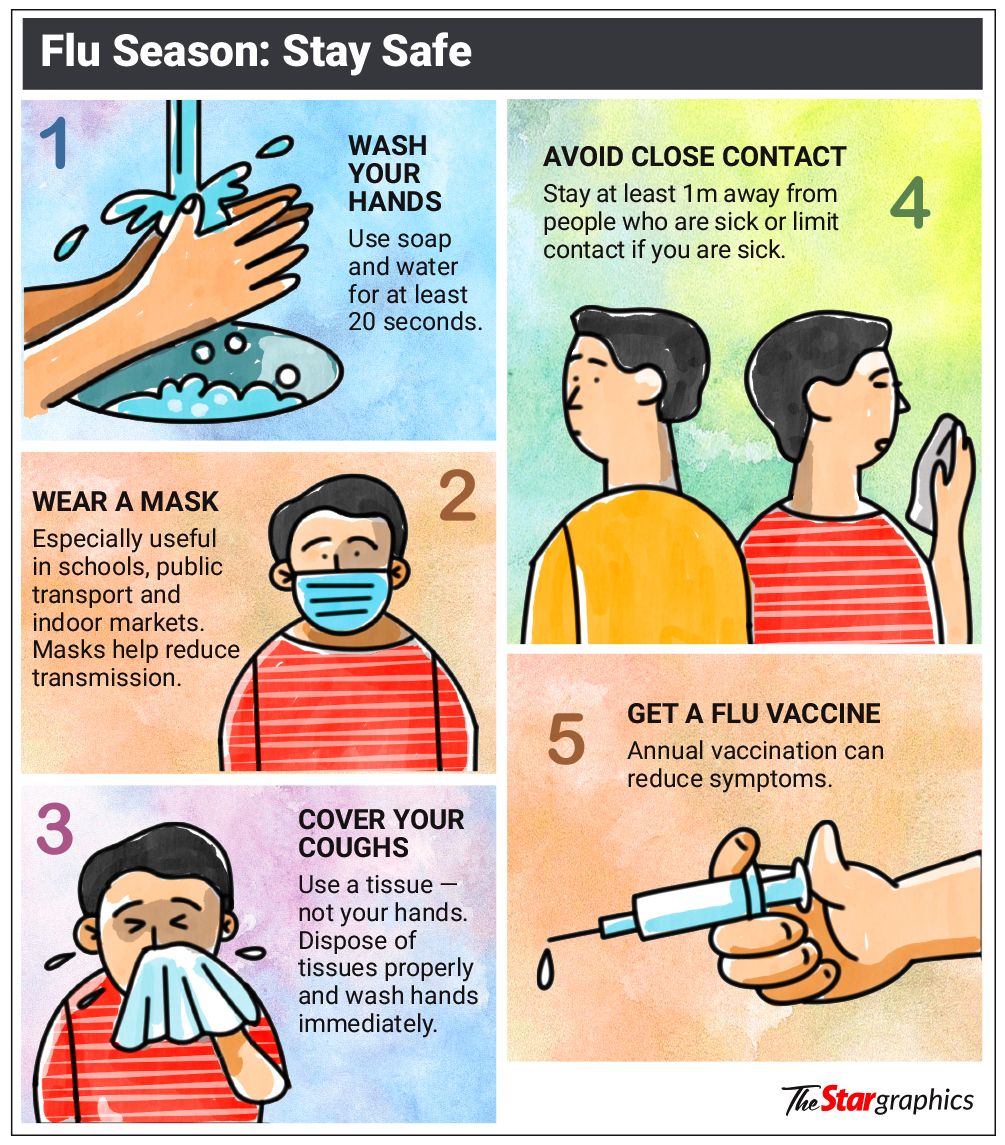
The ministry also urged the public to practise proper cough etiquette, maintain regular hand hygiene, avoid crowded places when unwell and wear face masks if they were symptomatic.

Health Minister Datuk Seri Dr Dzulkefly Ahmad said his ministry will discuss with the Education Ministry on further action to contain the spread of the virus in schools.

He also sought to reassure the public that the situation remained under control despite a concerning number of outbreaks.

Prof Sharifa Ezat, who is Univer­siti Kebangsaan Malaysia’s School of Liberal Studies dean, said high-risk groups in­­cluded the elderly, those with comor­bidi­ties, cancer patients and pregnant women.

She added that other groups, such as healthcare workers, teachers with high student load and those handling work which involves meeting a lot of people, should also mask up to protect themselves.

Malaysian Medical Association (MMA) president Datuk Dr Thiru­navukarasu Rajoo urged the public to take sensible precautions with cases of Influenza A and B continuing to rise nationwide.

He said the increase in flu clusters being detected by the Health Ministry was not unusual during this time of the year, but stressed that vigilance is key to preventing a further spread.

“Good hygiene remains our best defence – wash your hands frequently, cover coughs and sneezes and wear a mask if feeling unwell or in crowded areas,” he said.

Dr Thirunavukarasu advised those with persistent high fever, severe cough, chest discomfort or breathing difficulties to seek immediate medical attention, especially if symptoms did not improve after a few days.

President of the Association of Private Hospitals Malaysia Dr Kuljit Singh said the resulting increase in demand for flu vaccines is still manageable.

“We have stock from suppliers, despite the surge in cases,” he said, adding that demand for the jab usually goes up during the flu season.

Former Medical Practitioners Coalition Association of Malaysia president Dr Raj Kumar Maharajah also said there is enough stock of the vaccine at the moment.

“Many are coming in for vaccines due to the influenza outbreak,” he said.

Related stories:

Penang launches Silicon Island at World Expo


Ambitious plan: Chow described Silicon Island as one of Penang’s most ambitious projects, a 920ha reclaimed land development in southern Penang that mirrors Japan’s own Yumeshima Island.

“Silicon Island is not just a piece of land, it is a promise that Penang will continue to lead where innovation meets sustainability,” 


OSAKA: Penang has launched Silicon Island at the World Expo 2025, marking a historic milestone in a journey to reaffirm its position as the Silicon Valley of the East.

The launch, officiated by Penang Chief Minister Chow Kon Yeow, showcased the state’s bold vision to elevate Malaysia’s standing in the global electrical and electronics (E&E) industry while driving sustainable economic growth for decades to come.

In his keynote address, Chow drew parallels between Silicon Island and Yumeshima Island – the site of the World Expo – highlighting how this masterfully planned reclaimed island is set to become a world-class hub for innovation, technology and logistics, echoing the success of leading global tech clusters.

Chow described Silicon Island as one of Penang’s most ambitious projects, a 920ha reclaimed land development in southern Penang that mirrors Japan’s own Yumeshima Island.

“Silicon Island is not just a piece of land, it is a promise that Penang will continue to lead where innovation meets sustainability,” he said.

Strategically located just mi­­nutes from Penang International Airport, Silicon Island is designed to provide seamless global connectivity, enabling efficient movement of goods and talent – an essential advantage for the fast-growing E&E industry and its time-sensitive supply chains.

Meanwhile, the development of SilicoEight Samurain Island also pays tribute to Penang’s pioneering past.

Inspired by the legacy of the “Eight Samurai” – the trailblazing multinational corporations that established Penang’s first E&E ecosystem in Bayan Lepas – this project applies decades of hard-earned experience to captivate the world once again.

For the past 50 years, Bayan Lepas has been the lynchpin of Penang’s economy, anchoring Malaysia’s rise as a global E&E powerhouse. The next 50 years will be defined by Silicon Island – Penang’s new frontier for innovation, investment and sustainable growth.

Beyond industry, Silicon Island introduces a unique tourism proposition, blending innovation with lifestyle to create a destination where technology, sustainability and culture converge.

Sunday, October 12, 2025

Call for contingency plans in face of US govt shutdown


-Photo credit Reuters.

PETALING JAYA: Several export-oriented sectors in Malaysia will be impacted if there is a prolonged shutdown of the US government, say industry players.

As one of the country’s largest export markets, contingency plans should be drawn up to assist the affected sectors in weathering the effects of the political impasse in Washington DC.

Associated Chinese Chambers of Commerce and Industry of Malaysia treasurer-general Datuk Koong Lin Loong said that while the impact of a short-term shutdown would be minimal, an extended one would create a ripple effect on the US economy and Malaysian exporters.

“If US civil servants are not paid their salary, this will decrease their spending power and consumption. This in turn will affect the export of our furniture to the United States.

PETALING JAYA: Several export-oriented sectors in Malaysia will be impacted if there is a prolonged shutdown of the US government, say industry players.

As one of the country’s largest export markets, contingency plans should be drawn up to assist the affected sectors in weathering the effects of the political impasse in Washington DC.

Associated Chinese Chambers of Commerce and Industry of Malaysia treasurer-general Datuk Koong Lin Loong said that while the impact of a short-term shutdown would be minimal, an extended one would create a ripple effect on the US economy and Malaysian exporters.

“If US civil servants are not paid their salary, this will decrease their spending power and consumption. This in turn will affect the export of our furniture to the United States.

“Also, the shutdown will interrupt services such as customs clearance at the ports and entry points in the United States. This will become an issue for our exporters.

“The disruption to the logistics sector would have an impact on the supply chain.

“This will be especially true for Malaysian companies involved in the export of electrical and electronics (E&E) products to the United States, which is a major importer,” he said when contacted yesterday.

The United States is one of the largest importers of Malaysian E&E, totalling almost RM120bil last year and representing about 20% of the country’s total E&E exports.

Of these figures, some RM60bil were semiconductor products, which account for about 20% of Malaysia’s total semiconductor exports.

Koong suggests that Malaysia leverage its position as Asean Chair to coordinate with other Asean members states and regional countries in facilitating exports.

“We could leverage the strength of Asean as a whole in respect of the individual countries’ niche products and services,” he added.

If there is a prolonged shutdown, he said the government should assist exporters by exploring other potential markets such as the Middle East and Africa.

Koong noted that development grants and soft loans, which were announced in Budget 2026, could help small and medium enterprises (SMEs) weather the effects of a prolonged shutdown.

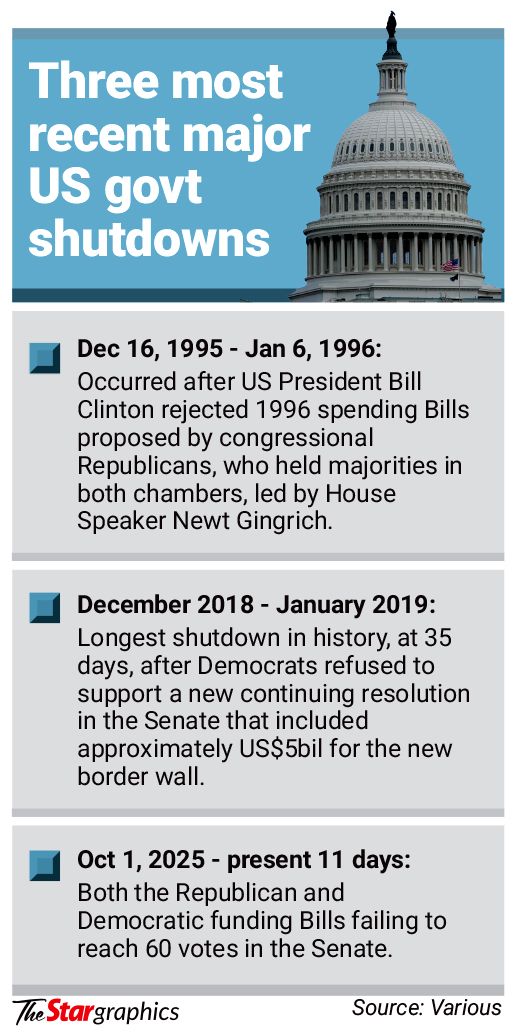
The US government shutdown, which began on Oct 1, was triggered by the US Congress’ rejection of a Republican funding Bill, resulting in some 750,000 federal government workers being furloughed without pay.

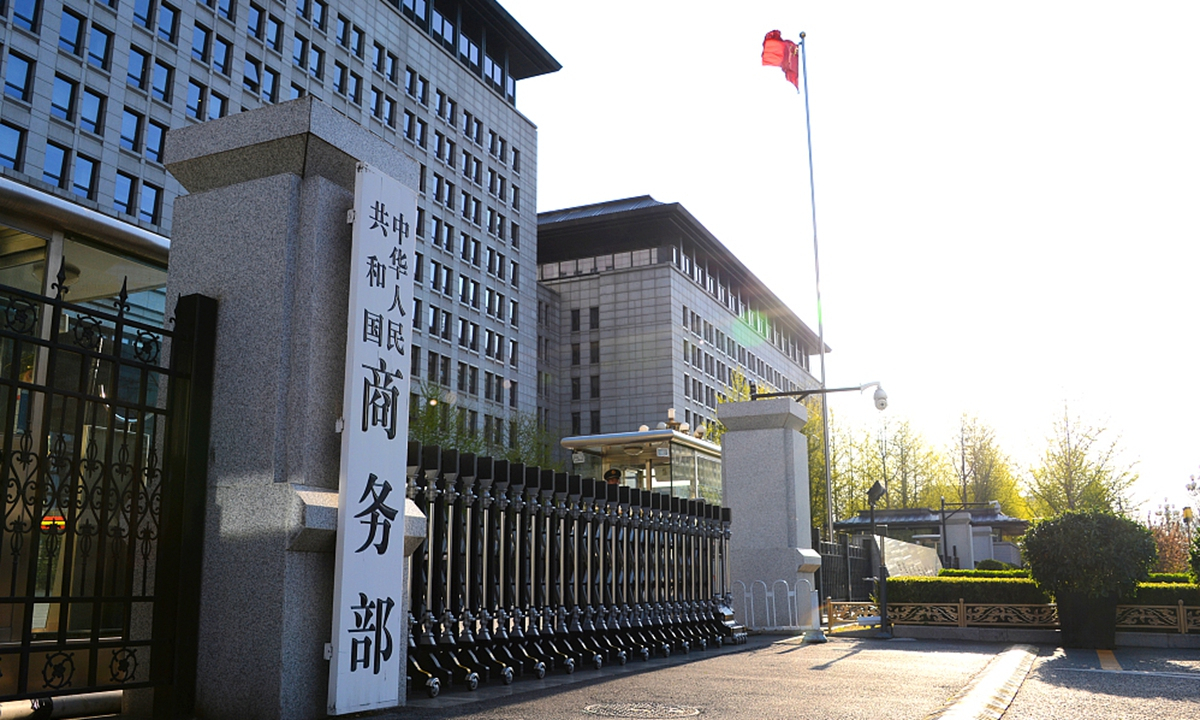
MOFCOM slams US' planned 100% additional tariff, says willful threats not right way to get along with China

China's Ministry of Commerce (MOFCOM) on Sunday slamm


The deadlock is expected to persist for a third week despite pressure from President Donald Trump on the Democrats to support the Republican Bill.

Airfreight Forwarders Association of Malaysia chairman Thomas Mathew said the shutdown, though a US domestic political issue, carries far-reaching implications for the global economy.

“As one of the world’s largest importers and exporters, any disruption in the operations of US federal agencies reverberates through supply chains worldwide,” he said when contacted yesterday.

Among the immediate impacts of the shutdown are delays in customs clearance, port congestion and slower regulatory processing by key US agencies, he added.

“This includes the Customs and Border Protection (CBP), the Department of Commerce, and the Food and Drug Administration (FDA).

“These delays can significantly disrupt the flow of goods into and out of the United States, prompting re-routing, rescheduling, and increased costs across shipping networks,” he said.

Mathew said a prolonged shutdown would have a multifaceted impact on Malaysia, as the country is a key trading partner of the United States, particularly in the E&E and manufacturing sectors.

“Malaysia may encounter delays in order fulfilment, payment cycles, and reduced demand from US buyers facing their own domestic uncertainties,” he said.

He added that there could also be logistical slowdowns affecting compliance-dependent sectors that require US regulatory approvals, such as semiconductors, medical devices and pharmaceuticals.

“Additionally, any resulting market volatility may impact the ringgit, investor confidence and broader business sentiment in Malaysia,” he said.

While a short-term shutdown can be absorbed with minimal disruption, a prolonged one risks undermining the predictability and efficiency upon which global trade and export-driven economies rely on.

Mathew suggests that contingency plans are drafted for the affected sectors.

“Diversifying trade partnerships will be key for Malaysian businesses navigating such external shocks,” he added.

Malaysian Consortium of Mid-Tier Companies honorary president Callum Chen said a prolonged shutdown would be a double whammy to businesses, not only globally but also Malaysian too.

“The impact will make things worse. Ports in the United States are already jam-packed with stuck containers due to tariff uncertainties.

“Most US SMEs are already facing cash flow problems due to the tariffs,” he said when contacted.

He added that unpaid US federal workers would be forced to prioritise their spending.

“They will have less money to buy things, and their priority will be putting food on the table,” he said.

Chen expects the latest episode to be longer than the previous 35-day shutdown from Dec 22, 2018, to Jan 25, 2019, which is the longest in US history.

“Everyone is in a limbo and this only creates more uncertainty for businesses,” he said.

https://www.thestar.com.my/news/world/2025/10/11/white-house-says-substantial-us-government-job-cuts-have-begun

https://www.thestar.com.my/news/nation/2025/10/12/experts-theres-a-silver-lining-amid-us-shutdown

Related posts:

  •   https://bbc.com/news/articles/crrj1znp0pyo Anthony Zurcher North America correspondent  and James FitzGerald   Watch: What could happen du...

Goodbye trade war

Goodbye trade war


China seems to be winning the tariff war even as Trump threatens to impose a massive increase of tariffs on Chinese imports in response to the republic's announcement of new export controls on rare earths. — Getty Images/AFP


South-east asia, once only a bruising trade war’s secondary victim, should now have asean showing its mettle as china wins.

BEYOND multiple global uncertainties are two core fundamentals: Us-china relations being the world’s most important bilateral relationship, and economics determining much of everything else.

This makes the trade war between the world’s two biggest economies pivotal to all. Multiple spheres in various regions are impacted accordingly.

That much is the main plot in today’s geopolitics. Problems tend to arise when the script is amended without warning, explanation or acknowledgement.

US President Donald Trump has sought a personal meeting with Chinese President Xi Jinping since last year, but that will happen only next year. Why does it take two years for such a crucial event to occur?

It is precisely because of the summit’s importance that it has to take so long. Unlike MOUS, summits do not set the tone of an intended agreement but to cap what has already been agreed.

Transnational deals are too important to be left to formal summits with their pomp and pageantry. The serious business of negotiations by government experts and specialists differs vastly from the PR theatre of official photo opportunities.

The months and years between signalling interest in a summit and actually holding it are for senior officials to work out sufficiently agreeable terms to constitute a deal. That period of talks by officials began informally last year between the incoming US administration and China’s incumbent team.

It is a period now effectively coming to a close in ending the trade war, but still only unofficially. The basic agreement that is now done in all but writing has the US broadly conceding to China’s terms.

China is the only country that has pushed back on Trump’s tariffs, with resounding effect as recent events show.

After Commerce Secretary Howard Lutnick’s grating condescension about supplying China with only Nvidia’s sub-par microchips, Beijing blocked all of Nvidia’s chips. Nvidia boss Jensen Huang said China’s own chip development is only “nano seconds behind” his company’s best products.

In agriculture, China has stopped buying US soybeans for supplies from Brazil and elsewhere. With US farmers devastated, China again demonstrated considerable leverage.

With Trump clamping down on countries buying Russian and Iranian oil and gas, India was hit with high additional tariffs, but not China. Instead, China raised Russian gas supplies with the Power of Siberia (POS) pipeline and now also POS 2.

China is also importing more than a million barrels of Iranian oil daily, amounting to almost 90% of Iran’s output. These major purchases were never going to be impacted by US restrictions.

Trump declared victory on Tiktok but it was a net gain for China. Beijing refused to sell Tiktok’s proprietary algorithm, the heart and brain of the winning platform.

A copy of the original algorithm was supplied to US investors, and China’s Bytedance owns just under 20% of US Tiktok – yet is entitled to 50% of US profits. US negotiators must have realised that was the most they could get from China’s tough bargaining position and accepted it.

China has introduced new restrictions on rare earth exports, launched an antitrust probe into US chip giant Qualcomm, and will raise port fees for US ships in return. In virtually every sector China is fighting back through tit-for-tat action and new policies.

If there is still any doubt that China is leading the charge of what remains of the trade war, its use of carrots and sticks to access the US market confirms it. Beijing has offered more than a trillion dollars (RM4.2 trillion) of investment in the US through Chinese companies admitted there.

These could include Chinese electric vehicle companies, which Trump last year said he would invite to the US to provide jobs. Only the stronger economy can dish out inducements of such proportions to the relatively subordinate economy.

Such is the substance of a negotiated trade peace. Ultimately, Trump is less concerned about what actually makes a trade victory than what can be interpreted and portrayed as his personal triumph.

He is anxious to gain snatches of a win between trade skirmishes, however fleeting or questionable, and China is only too happy to provide them to win the trade war. More of this can be expected at next year’s summit.

Meanwhile, Louis Gave of Hong Kong’s Gavekal Research has declared China’s trade war victory. South-east Asia should likewise flip the old script to its favour.

Asean countries are not just collateral economies subjected to the whims of a trade conflict. When China takes a beating, South-east Asia was assumed to be beaten also.

But the US still hopes to obtain from this region what it failed to get from China. To do this it needs to keep up appearances that it is winning over China as the centre of global supply chains.

Asean can call that bluff to protect itself.

Repated posts|:

  •   https://bbc.com/news/articles/crrj1znp0pyo Anthony Zurcher North America correspondent  and James FitzGerald   Watch: What could happen du...

Call for contingency plans in face of US govt shutdown


Friday, October 10, 2025

Taiwan celebrates Double Tenth Day with colorful performances, showcasing diversity and unity. President Li Ching-du offers a conciliatory tone towards China while emphasizing Taiwan


4:51 YouTube · TaiwanPlus News How Taiwan's National Day Went From Military Parade to ... YouTube · TaiwanPlus News 3 hours ago 15:01 YouTube · TaiwanPlus News Double Ten National Day, What's Up Taiwan – News at 14:00 ... YouTube · TaiwanPlus News 10 Oct 2024 Taiwan celebrates Double Tenth Day with colorful performances, showcasing diversity and unity. President Li Ching-du offers a conciliatory tone towards China while emphasizing Taiwan