Pages

Share This

Deepseek https://www.deepseek.com/./深度求索 DeepSeek | 深度求索
Showing posts with label EPF. Show all posts

Friday, March 6, 2026

RM79.6bil windfall for EPF members


'CLICK TO ENLARGE'

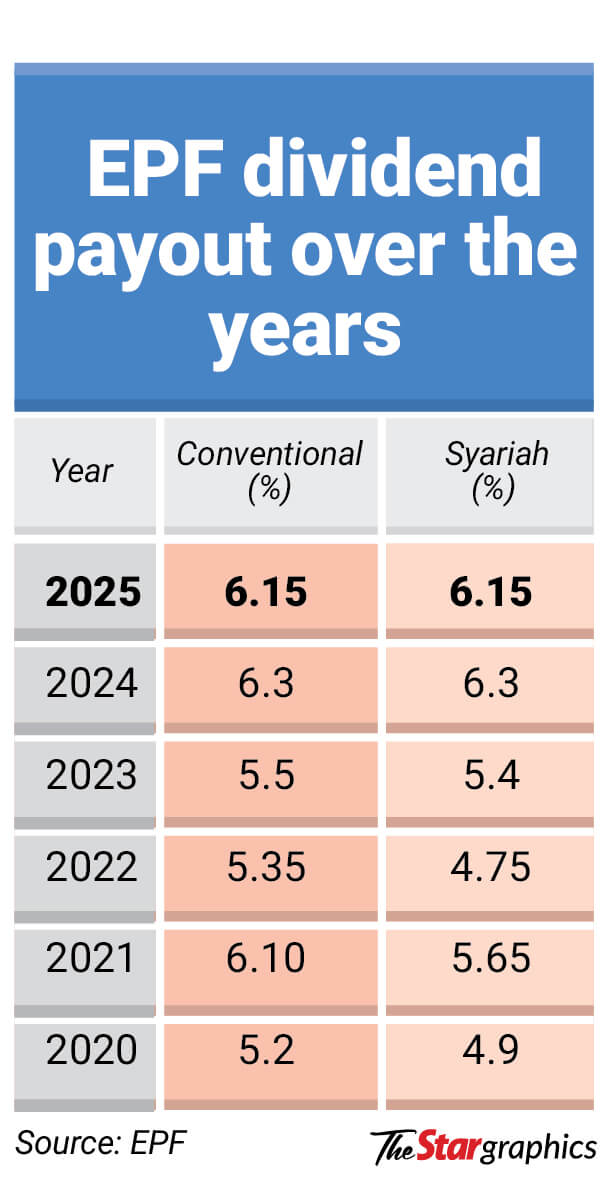
SHAH ALAM: The Employees Provident Fund (EPF) has declared a lower dividend for 2025 at 6.15% for both conventional and syariah accounts.

The total dividend payout for 2025 is RM79.6bil, whereby RM67.1bil is for conventional accounts and RM12.5bil for syariah accounts.

For 2024, the EPF declared a dividend rate of 6.3% for conventional savings with a total payout of RM63.05bil, as well as a 6.3% dividend for syariah savings, with a payout amounting to RM10.19bil.

EPF chief executive officer Ahmad Zulqarnain Onn attributed the lower payment to the slower growth of Bursa Malaysia’s Kuala Lumpur Composite Index (KLCI), which grew at 2.3% last year compared to about 12.9% in 2024.

Secondly, he said, assets denominated in the US dollar were also impacted due to the strength of the local currency.

The strengthening of the ringgit against the US dollar “impacted the value in ringgit of our income from dollar assets”, he said during the retirement fund’s dividend announcement yesterday.

“The ringgit does impact our international holdings and it was one of the best-performing currencies in the world, gaining 10.2%.”

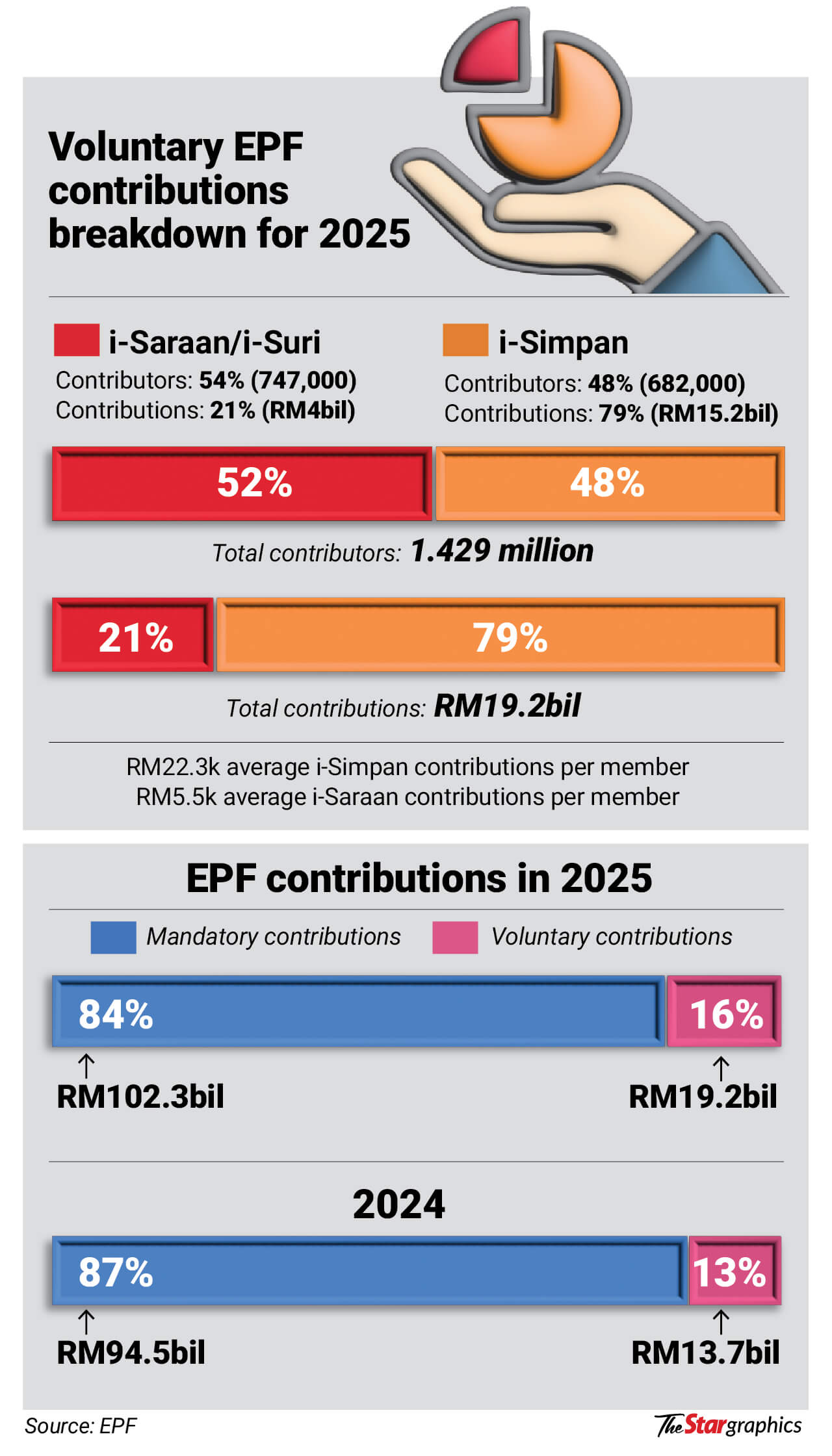
The EPF recorded a total investment income of RM79.2bil for 2025, up from the RM74.46bil reported in 2024.

Investment assets grew to RM1.409 trillion, which is a 12.8% increase from the RM1.25 trillion recorded in the previous year, driven by portfolio income and net contributions of RM66.5bil.
'CLICK TO ENLARGE'
'CLICK TO ENLARGE'

The EPF recorded a total distributable income of RM82.7bil for 2025, up 9.5% from RM75.5bil in 2024.

Domestic investments continued to provide steady income, with 61.7% of the RM1.409 trillion worth of assets invested domestically. They generated investment income of RM39.3bil and accounting for 49.6% of total investment income.

Global investments, representing 38.3% of the portfolio, generated RM39.9bil and accounted for 50.4% of total investment income.

Ahmad Zulqarnain said the outlook for 2026 is moderate in the face of uncertainties.

“We believe economic growth will continue to be within expectations for most parts of the world, including continued growth in Malaysia,” he noted.

“Malaysia delivered 5.2% in 2025; the estimates are 4.3% for this year. But as we know, we also live in a world of great uncertainties, more so today than it has been for many decades.

“The risks are around trade policies, geopolitics, the path of inflation and, therefore, monetary policy and interest rates, increasing public debt, and the impact of artificial intelligence, which will create new winners and new losers. We believe Malaysia is in a good place,” he added.

“The top three themes for Malaysia that we believe will be persistent for the next decade are healthcare as we age as a nation, artificial intelligence, data and digitalisation as our personal and work lives become more and more digital, and energy as the world transitions to green energy.”
'CLICK TO ENLARGE'
'CLICK TO ENLARGE'

Meanwhile, the EPF will introduce the i-Legasi scheme, enabling contributors aged 55 and above to pass down their retirement savings to their children.

This scheme allows contributors to transfer their savings “intergenerationally” to their children. However, this applies only to members who are already eligible to withdraw their savings.

Ahmad Zulqarnain also said EPF dividends must be credited into the correct account as provided for under the law.

“If the savings are in Account 1 or Account 2, the dividends must be credited into those accounts,” he said.

“We cannot take dividends from other accounts and transfer them,” he said in reference to Arau MP Datuk Seri Shahidan Kassim’s suggestion that the dividends be channelled to the flexible account.

Silver EPF lining

6.15% dividend for conventional, syariah accounts

'CLICK TO ENLARGE'

SHAH ALAM: The Employees Provident Fund (EPF) has declared a lower dividend for 2025 at 6.15% for both conventional and syariah accounts.

The total dividend payout for 2025 is RM79.6bil, whereby RM67.1bil is for conventional accounts and RM12.5bil for syariah accounts.

For 2024, the EPF declared a dividend rate of 6.3% for conventional savings with a total payout of RM63.05bil, as well as a 6.3% dividend for syariah savings, with a payout amounting to RM10.19bil.

EPF chief executive officer Ahmad Zulqarnain Onn attributed the lower payment to the slower growth of Bursa Malaysia’s Kuala Lumpur Composite Index (KLCI), which grew at 2.3% last year compared to about 12.9% in 2024.

Secondly, he said, assets denominated in the US dollar were also impacted due to the strength of the local currency.

The strengthening of the ringgit against the US dollar “impacted the value in ringgit of our income from dollar assets”, he said during the retirement fund’s dividend announcement yesterday.

“The ringgit does impact our international holdings and it was one of the best-performing currencies in the world, gaining 10.2%.”

The EPF recorded a total investment income of RM79.2bil for 2025, up from the RM74.46bil reported in 2024.

Investment assets grew to RM1.409 trillion, which is a 12.8% increase from the RM1.25 trillion recorded in the previous year, driven by portfolio income and net contributions of RM66.5bil.

'CLICK TO ENLARGE'
'CLICK TO ENLARGE'

The EPF recorded a total distributable income of RM82.7bil for 2025, up 9.5% from RM75.5bil in 2024.

Domestic investments continued to provide steady income, with 61.7% of the RM1.409 trillion worth of assets invested domestically. They generated investment income of RM39.3bil and accounting for 49.6% of total investment income.

Global investments, representing 38.3% of the portfolio, generated RM39.9bil and accounted for 50.4% of total investment income.

Ahmad Zulqarnain said the outlook for 2026 is moderate in the face of uncertainties.

“We believe economic growth will continue to be within expectations for most parts of the world, including continued growth in Malaysia,” he noted.

“Malaysia delivered 5.2% in 2025; the estimates are 4.3% for this year. But as we know, we also live in a world of great uncertainties, more so today than it has been for many decades.

“The risks are around trade policies, geopolitics, the path of inflation and, therefore, monetary policy and interest rates, increasing public debt, and the impact of artificial intelligence, which will create new winners and new losers. We believe Malaysia is in a good place,” he added.

“The top three themes for Malaysia that we believe will be persistent for the next decade are healthcare as we age as a nation, artificial intelligence, data and digitalisation as our personal and work lives become more and more digital, and energy as the world transitions to green energy.”

'CLICK TO ENLARGE'
'CLICK TO ENLARGE'

Meanwhile, the EPF will introduce the i-Legasi scheme, enabling contributors aged 55 and above to pass down their retirement savings to their children.

This scheme allows contributors to transfer their savings “intergenerationally” to their children. However, this applies only to members who are already eligible to withdraw their savings.

Ahmad Zulqarnain also said EPF dividends must be credited into the correct account as provided for under the law.

“If the savings are in Account 1 or Account 2, the dividends must be credited into those accounts,” he said.

“We cannot take dividends from other accounts and transfer them,” he said in reference to Arau MP Datuk Seri Shahidan Kassim’s suggestion that the dividends be channelled to the flexible account.

Silver EPF lining

6.15% dividend for conventional, syariah accounts

 The good news is 41% of contributors have met the RM240,000 minimum savings, and parents can now pass down their retirement funds to their ...Read more

Steady and reassuring' ... Although the dividend is slightly lower than last year's 6.3%, she described the rate as “steady and reassuring”.Read more


ration-color: initial;">
 The good news is 41% of contributors have met the RM240,000 minimum savings, and parents can now pass down their retirement funds to their ...Read more

Saturday, January 9, 2021

Generating sustainable retirement income


Many Malaysian are EPF contributors and have FDs as well. "You will never understand how bad the feeling is when you have to break your fixed deposit to cover your living expenses."

ONE of the top financial concerns of retirees is running out of money.

Whether you were an executive earning a reasonable income, or if you are making top dollars as a businessman, the fear is still valid.

For example, Tommy, who left the working world soon after selling his factory to a European multinational corporation. Tommy shared during one of our meetings that he was golfing every week and globe trotting almost every other month.

However, there was a problem that greatly bothered him. He found that he was dipping into his fixed deposit every now and then just to maintain his interesting lifestyle.

“Yap, you will never understand how bad the feeling is when you have to break your fixed deposit to cover your living expenses, ” he said.Combing through all of his finances, we discovered that Tommy’s lackadaisical attitude was to be blamed. He has not been paying enough attention to invest and generate income from the RM12mil nest egg that he had painstakingly accumulated. His investment portfolio was a mess.

Over the years, he invested in a few properties but never really bothered to oversee them. When tenants left, he didn’t make an effort to secure new tenants. In fact, some properties were even sitting vacant and idle. His excuse? He was too busy running the business.

Yap Ming Hui
Yap Ming HuiYap Ming Hui

Tommy has also invested in some shares and unit trusts but he seldom monitors and reviews their performances. Imagine his surprise when he went looking for some extra cash but discovered that most of the investments were not making money. Prior to meeting me, he couldn’t decide whether to sell or to keep those underperforming investments.

Consequently, the bulk of Tommy’s wealth is in fixed deposit. The trouble is the interest income from fixed deposit barely covers the impact of inflation. As such, if Tommy continues to spend on his interest income, he will risk having the principal depleted.

Asset rich, income poor

Tommy’s problem is a typical case of “Asset Rich, Income Poor.” His situation is definitely not unique. In fact, I find most self-made millionaires or business owners, typically strong at creating wealth from their business or professional career, but poor at generating income and gain from the created wealth.

For one, all the time spent ensuring their businesses succeed also takes them away from making sure that the wealth created is optimised.Let’s examine Tommy’s assets and see how it measures up (see chart).

The RM6mil in fixed deposit generate approximately 2% interest income. However, notice that the 2% of interest is not sufficient to offset the 4% inflation provision. As a result, there is negative net income coming from Tommy’s fixed deposit asset.

Tommy’s properties are worth RM3mil and only generates RM50,000 in rental income per annum. Nevertheless, this can be considered a net income because inflation will be hedged by capital appreciation (at least 4% per annum) of the properties.

The RM1mil in shares gives a total return of 5%. Factoring 4% inflation, the actual income received from share investment is RM10,000.

Unfortunately, the RM2mil unit trust investments didn’t offer any returns. After inflation provision, his unit trust investment has a net income of RM80,000.

The reality is if nothing is done now, Tommy’s wealth will continue to shrink by RM140,000 a year once inflation is factored to the equation. How does this play out for Tommy? The fact that he needs RM360,000 a year to maintain his current lifestyle will not augur well for him.

So, how can you prevent from ending up in Tommy’s situation?

The optimisation measures

> Remember to review the performance of each of your investment asset classes. In order to generate more income and gains, be proactive in getting rid of poor quality and poor performing investments. Look at each investment and ask yourself, should you keep it or should you sell?

> Consider moving fixed deposit into higher return investment.

Any gains from your fixed deposit would probably be eroded by inflation, especially given the current low interest, which will probably persist for quite some time. After calculating and providing for your emergency fund cash reserves, the balance of your fixed deposit should be invested into other investments that can generate higher return and income to hedge against inflation.

> Diversify the source of retirement income

Even if one investment asset can give you a good income and hedge against inflation, it does not mean that you must bet all or the majority of your wealth in it. For example, property investing. Some investors have found success in it. They were able to generate good capital appreciation and rental income.

As a result, they put a majority, if not all, of their wealth into properties. It may sound logical at first but rental income is not sustainable in the long run. It is subjected to changes, some of which cannot be controlled. Therefore, the best practice is still to diversify your retirement income across different asset classes, like share dividends and capital gains, unit trust gains, bond investment gains, retirement income products and others, so that it is not badly affected by any one impact.

The ability to grow your wealth during retirement years is important. Just because you have stopped working, it does not mean your money should stop working too. The idea behind wealth optimisation is to ensure that you can upkeep your retirement lifestyle and protect your wealth from inflation.

Ideally, one should get a plan done a few years prior to retirement to see how your retirement income would play out. After all, you wouldn’t want to have any unpleasant surprise, like in Tommy’s case. When you have time on your side, you can improve your investing skills and adjust your retirement plan accordingly while still in your active income earning years.

Yap Ming Hui is a licensed financial planner. The views expressed here are the author’s. Any reliance you place on the information https://www.thestar.com.my/business/business-news/2021/01/09/generating-sustainable-retirement-incomeshared is therefore strictly at your own risk.

 Source link


Related posts:


Promoting women entrepreneurs; mind your finances


Friday, February 28, 2020

Malaysia's economic stimulus package of RM20bil to mitigate Covid-19 impact

https://www.thestar.com.my/news/nation/2020/02/28/gdp-target-within-reach?jwsource=cl

Minimum EPF contribution by employees to be reduced by 4% from 11% to 7%, with effect from Apr 1 to Dec 31, 2020. This will potentially unlock up to RM10 billion worth of private consumption. Malaysian workers have the option to opt out from the scheme and maintain their contribution rate
    KUALA LUMPUR: Tun Dr Mahathir Mohamad had on Thursday unveiled the RM20bil stimulus package to offset the fallout from the Covid-19 coronavirus.

    Below are the highlights:

  • Based on three strategies: counter Covid-19 impact, boost people-based growth, encourage quality investments 

  • • Bank Simpanan Nasional provides RM200mil micro credit at 4% interest rate

  • • MAHB to cut rental for tenants, landing charges and parking fees at airports

  • • Postponement of income tax monthly payment for tourism-related companies

  • • Bank Negara provides RM2bil guaranteed financial aid for SMES at 3.75% interest rate

  • • All banks required to reduce monetary burden in the form of postponement of payments or rescheduling of loans

  • • Temporary six months discount of as much as 15% for electricity bills for hotels, tourism agencies, airlines, and shopping centres

  • • Hotels to get service tax breaks from next month to august

  • • Economic growth for 2020 expected to be between 3.2% and 4.2%

  • • Minimum EPF contribution by employees to be reduced from 11% to 7%, with effect from april 1 to dec 31. This could unlock up to RM10bil worth of private consumption. Malaysian contributors have the choice to opt out from the scheme and maintain their contribution rate

  • • A payment of RM200 to all bantuan Sara Hidup (BSH) recipients scheduled for May will be brought forward to March. an additional RM100 will be paid into the bank accounts of all BSH recipients in May. Subsequently, an additional rM50 will be channelled in the form of e-tunai

  • • As a result of the stimulus package, fiscal deficit estimated to increase to 3.4% of GDP from targeted 3.2%

  • • Grants of RM1,000 to RM10,000 for entrepreneurs to promote the sale of their products on e-commerce platforms

  • • Securities Commission and bursa Malaysia will waive listing fees for one year, for companies seeking listing on Leading entrepreneur accelerator Platform (LEAP) or Access, Certainty, Efficiency (ACE) markets, as well as companies with market capitalisation of less than RM500mil seeking listing on the main market

  • • Import duty and sales tax exemption on importation or local purchase of machinery and equipment used in port operations for three years commencing april 1

  • • Enough source of money for now, no issuance of bonds needed

  • • Stimulus package to be funded by RM2 trillion savings from bank Negara, Tabung Haji, EPF

  • • Bureaucratic procedures will be expedited to disburse stimulus

Read more:

Malaysia's economic stimulus package of RM20bil to mitigate Covid-19 impact

https://www.thestar.com.my/news/nation/2020/02/28/gdp-target-within-reach?jwsource=cl

Minimum EPF contribution by employees to be reduced by 4% from 11% to 7%, with effect from Apr 1 to Dec 31, 2020. This will potentially unlock up to RM10 billion worth of private consumption. Malaysian workers have the option to opt out from the scheme and maintain their contribution rate
    KUALA LUMPUR: Tun Dr Mahathir Mohamad had on Thursday unveiled the RM20bil stimulus package to offset the fallout from the Covid-19 coronavirus.

    Below are the highlights:

  • Based on three strategies: counter Covid-19 impact, boost people-based growth, encourage quality investments 

  • • Bank Simpanan Nasional provides RM200mil micro credit at 4% interest rate

  • • MAHB to cut rental for tenants, landing charges and parking fees at airports

  • • Postponement of income tax monthly payment for tourism-related companies

  • • Bank Negara provides RM2bil guaranteed financial aid for SMES at 3.75% interest rate

  • • All banks required to reduce monetary burden in the form of postponement of payments or rescheduling of loans

  • • Temporary six months discount of as much as 15% for electricity bills for hotels, tourism agencies, airlines, and shopping centres

  • • Hotels to get service tax breaks from next month to august

  • • Economic growth for 2020 expected to be between 3.2% and 4.2%

  • • Minimum EPF contribution by employees to be reduced from 11% to 7%, with effect from april 1 to dec 31. This could unlock up to RM10bil worth of private consumption. Malaysian contributors have the choice to opt out from the scheme and maintain their contribution rate

  • • A payment of RM200 to all bantuan Sara Hidup (BSH) recipients scheduled for May will be brought forward to March. an additional RM100 will be paid into the bank accounts of all BSH recipients in May. Subsequently, an additional rM50 will be channelled in the form of e-tunai

  • • As a result of the stimulus package, fiscal deficit estimated to increase to 3.4% of GDP from targeted 3.2%

  • • Grants of RM1,000 to RM10,000 for entrepreneurs to promote the sale of their products on e-commerce platforms

  • • Securities Commission and bursa Malaysia will waive listing fees for one year, for companies seeking listing on Leading entrepreneur accelerator Platform (LEAP) or Access, Certainty, Efficiency (ACE) markets, as well as companies with market capitalisation of less than RM500mil seeking listing on the main market

  • • Import duty and sales tax exemption on importation or local purchase of machinery and equipment used in port operations for three years commencing april 1

  • • Enough source of money for now, no issuance of bonds needed

  • • Stimulus package to be funded by RM2 trillion savings from bank Negara, Tabung Haji, EPF

  • • Bureaucratic procedures will be expedited to disburse stimulus

Read more: