Pages

Share This

Deepseek https://www.deepseek.com/./深度求索 DeepSeek | 深度求索

Friday, September 25, 2026

Bell’s Palsy, bell's palsy (FACE STROKE)


Medically Reviewed.Last updated on 08/14/2023.

Bell’s palsy temporarily weakens or paralyzes facial muscles. People with Bell’s palsy develop a droopy appearance on one — or sometimes both — sides of their face. The condition usually isn’t serious and often goes away in a few months without treatment.

Overview

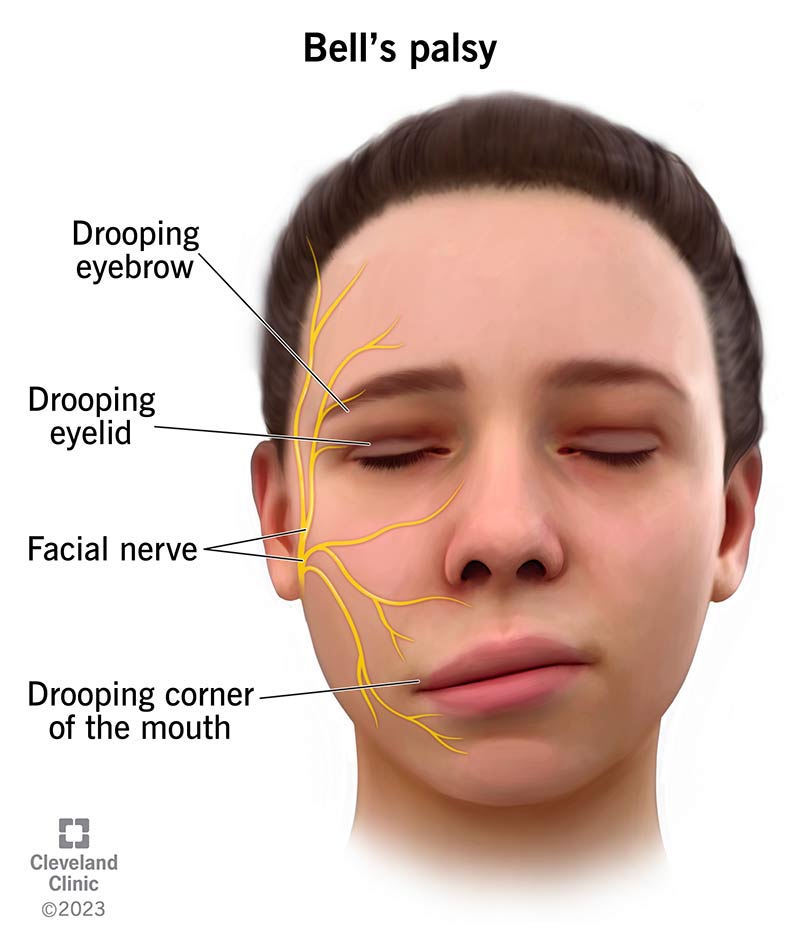
Illustration showing the face of a person with an inflamed facial nerve and drooping of their eyebrow and mouth.
Bell’s palsy is a condition that causes temporary facial paralysis.

What is Bell’s palsy?

Bell’s palsy is a condition that causes temporary facial paralysis (palsy). It usually only affects the muscles on one side of your face. You may have a lopsided smile or an eyelid that you can’t fully close. It rarely affects both sides of your face.

Bell’s palsy happens when there’s inflammation and swelling of your seventh cranial nerve — the nerve that controls facial muscles. Certain conditions (like viral infections) can cause inflammation, but many cases of Bell’s palsy have no clear cause (idiopathic).

Bell’s palsy can affect anyone at any age. But it’s most likely to affect people between the ages of 15 and 60. The average age of onset is 40 years.

The condition gets its name from Sir Charles Bell, a Scottish surgeon who first described it during the 19th century.

Is Bell’s palsy a serious condition?

Bell’s palsy isn’t a serious condition. Most cases go away on their own with time. However, the symptoms of Bell’s palsy are similar to those of serious medical conditions, like a stroke. This is why it’s important to see a healthcare provider as soon as you notice muscle weakness in your face.

Signs of a stroke include:

A stroke is a life-threatening emergency condition where every second counts. If you or someone with you has symptoms of a stroke, IMMEDIATELY call 911 (or your local emergency services number).

How common is Bell’s palsy?

Bell’s palsy is relatively common. About 15 to 30 people out of 100,000 develop it every year. About 1 in 60 people will get it at some point in their life. It’s the most common cause of one-sided facial paralysis.

Symptoms and Causes

What are the symptoms of Bell’s palsy?

The main sign of Bell’s palsy is facial muscle paralysis — usually on one side of your face. It looks like one side of your face is drooping. This includes your:

  • Forehead.
  • Eyebrow.
  • Eye and eyelid.
  • Corner of your mouth.

Symptoms of Bell’s palsy tend to come on suddenly and reach peak severity within 48 to 72 hours. Some people develop mild facial muscle weakness. Others experience total muscle paralysis in their face.

It’s difficult to make full expressions with Bell’s palsy. Wrinkling your forehead, blinking and grimacing may be difficult or impossible on the affected side. Your face may feel numb or heavy. But you can still feel touch and temperatures (like heat and coolness) on the affected side of your face.

Other symptoms of Bell’s palsy may include:

Are there warning signs of Bell’s palsy?

Early symptoms of Bell’s palsy — or warning signs — may include a slight fever and pain behind your ear. However, there’s nothing you can do to stop Bell’s palsy from developing once it begins. In addition, you could have these symptoms for another reason and not develop Bell’s palsy.

What causes Bell’s palsy?

Inflammation and compression of your seventh cranial nerve is the main cause of Bell’s palsy.

The seventh cranial nerve carries nerve signals that control your facial movements and expressions. It also carries nerve signals involved in taste and producing tears in your eyes. You have two of these nerves — each controlling one side of your face. When one becomes inflamed, it affects how you can move the muscles on one side of your face.

Scientists have found that some viral infections may trigger inflammation of the seventh cranial nerve and cause Bell’s palsy. They include:

Other triggers may include having a weakened immune system from:

Healthcare providers usually can’t find a specific trigger of Bell’s palsy.

What are the risk factors for Bell’s palsy?

Having the following may increase your risk of getting Bell’s palsy:

Diagnosis and Tests

How is Bell’s palsy diagnosed?

Your healthcare provider can diagnose Bell’s palsy based on your symptoms. They’ll ask about when your symptoms started and if they’ve changed. They’ll also do a physical exam and ask you to try to move your facial muscles in certain ways. The key physical exam finding of Bell’s palsy is partial or complete weakness of your forehead.

Other conditions, including stroke, sarcoidosis, Lyme disease, middle ear bacterial infections, multiple sclerosis and tumors near your facial nerve can sometimes cause facial paralysis that’s similar to Bell’s palsy. Your provider can usually accurately diagnose Bell’s palsy based on your history of symptoms and examination alone. But they may sometimes suggest that you have one or more of these tests:

Management and Treatment

How is Bell’s palsy treated?

Most cases of Bell’s palsy improve without treatment. Still, your healthcare provider may recommend one or more of these therapies for symptom relief and faster recovery:

  • Eye care: Eye drops, including artificial tears, soothe dry, irritated eyes. If your eyelid won’t close, you may need to wear an eye patch to protect that eye from drying, irritants and injuries. Eye care is very important to prevent damage to your cornea, a serious complication of Bell’s palsy.
  • Oral corticosteroids: Oral corticosteroids (like prednisone) can help decrease nerve swelling. It may help you regain facial movement faster. This treatment is most effective when you start it within 48 hours of noticing symptoms.
  • Antiviral medications: Antiviral medications may speed up recovery. But it’s unclear how much benefit they provide. Providers typically only prescribe them for severe Bell’s palsy. This treatment works best when you combine it with oral corticosteroids.
  • Electrical stimulation: Although some providers recommend electrical stimulation to prevent facial muscle loss after Bell’s palsy, studies haven’t shown any benefit of this treatment.

In the rare case that Bell’s palsy doesn’t go away, functional facial plastic surgery procedures are an option. They can help correct facial asymmetry and assist with eyelid closure.

Outlook / Prognosis

How long does Bell’s palsy last?

Bell’s palsy can last a few weeks to six months. Symptoms usually start to gradually improve in three weeks. Up to 80% of people fully recover and show no signs of Bell’s palsy within three months.

Bell’s palsy can come back (recur) later in life. This happens to about 5% to 10% of people who’ve had it.

Is Bell’s palsy permanent?

Most cases of Bell’s palsy aren’t permanent. After some time, you’ll likely regain your full normal facial muscle function. This happens in about 80% of cases.

For others, facial weakness can be long-lasting. The longer the recovery, the more likely you’ll have lasting issues. The risk factors that are associated with poor outcomes include:

  • Complete facial paralysis.
  • Being over 60.
  • Having decreased salivation or taste.

Prevention

How can I prevent Bell’s palsy?

Unfortunately, there’s nothing you can do to prevent Bell’s palsy. It’s linked to certain viral infections, but not everyone who has those viral infections develops Bell’s palsy.

If you have risk factors for the condition, like diabetes, obesity or high blood pressure, managing them well may help reduce your risk.

Living With

When should I see my healthcare provider about Bell’s palsy?

If you have facial drooping, see a healthcare provider as soon as possible. Facial drooping is also a symptom of serious medical conditions, like a stroke. It’s better to know the cause right away.

Taking corticosteroids soon after symptoms of Bell’s palsy begin may also help speed up your recovery.

If you’ve received a diagnosis of Bell’s palsy, you should see your healthcare provider if you experience:

  • Symptoms that don’t improve within three months.
  • Chronic eye irritation.
  • An eyelid that won’t close.
  • Dehydration due to difficulty drinking and swallowing.
  • Hearing loss or dizziness/vertigo.

A note from Cleveland Clinic

If you get Bell’s palsy, you may be embarrassed by how your face looks. The good news is that these symptoms usually improve with time. See your healthcare provider when you first get symptoms. Corticosteroid treatments can speed recovery if you start them within 48 hours of noticing symptoms. Your provider can also rule out other, more serious conditions that cause facial paralysis.


Bell's palsy causes sudden weakness or paralysis on one side of the face, but it is not a stroke, though emergency medical help should be sought immediately if facial drooping occurs to rule out a stroke. [1, 2]

  • Mayo Clinic
    Bell's palsy - Symptoms and causes - Mayo Clinic
    Mild weakness to total paralysis on one side of the face — occurring within hours to days. Facial droop and trouble making facial ...
  • UCSF Otolaryngology
    How to Tell the Difference Between Bell’s Palsy vs. Stroke | Otolaryngology
    Bell's palsy and stroke can both cause single-sided facial paralysis. Symptoms include: * Facial drooping * Inability to close the...
  • National Institute of Neurological Disorders and Stroke (.gov)
    Bell's Palsy | National Institute of Neurological Disorders and Stroke
    This information does not constitute medical advice or diagnosis. Bell's palsy is a neurological disorder that causes paralysis or...
Show all

Friday, September 11, 2026

Bill Gates warns world unprepared for AI upheaval: We are not really for AI

 Gates, the Microsoft co-founder, said he saw three main risks arising from the fast deployment of AI. — AFP

WASHINGTON: Bill Gates warned on Aug 26 that the world is dangerously unprepared for the upheaval brought by artificial intelligence (AI), with the technology destroying jobs and threatening human connection, especially for young people.

In a nearly 6,000-word essay published on his blog, the Microsoft co-founder said the shift into the AI era will rank among the most turbulent periods in human history and that no one has produced a credible plan for managing it.

His stance will draw significant pushback from many in Silicon Valley and the Trump administration who blame "doomer" attitudes among some tech leaders for giving the AI revolution a bad reputation.

"AI will either be the greatest equaliser ever invented, or the worst source of injustice," wrote Gates, 70, who now chairs the philanthropic foundation that bears his name.

"There is no plan to ease the entry into the AI era," Gates said, adding that he would likely support one if it existed.

"However, I don't think that's going to happen. The geopolitical and economic incentives are pushing too hard to go full speed ahead," he warned.

Gates said he saw three main risks arising from the fast deployment of AI.

The first is permanent job destruction. Gates insisted comparisons to the shift from farm work to office work were misleading, as that transition unfolded over generations and created roles that still required human thinking.

AI can substitute for thinking itself, he warned, hitting law, medicine, customer service, software and manufacturing within roughly a decade.

Entry- and mid-level positions are the most exposed, Gates said, leaving young people entering a labour market with far fewer openings.

Blue-collar work will follow as robots become cheaper, with the construction and hospitality sectors feeling pressure by the end of the decade.

Gates suggested that some jobs should be set aside for humans, even if AI can do them better and more cheaply.

The second risk is that AI hands new capabilities to bad actors.

Gates said cybersecurity specialists he knows are alarmed that attackers are gaining ground faster than defenders can patch weaknesses.

Hospitals, banks, water systems and power grids are all exposed, he said.

The third area of risk concerns children and human relationships.

Citing research, Gates said AI chatbots that never challenge or frustrate users risk becoming addictive and denying people the chance to build social skills.

AI bots "rob us of the lessons we learn from connecting with other people," he wrote.

Gates acknowledged he retains deep financial ties to the technology industry, saying investment profits will flow to his foundation, which plans to spend its remaining US$200bil (RM805.4bil) over the next two decades.

The essay comes months after Gates was interviewed by the House Oversight Committee over his ties to the late sex offender Jeffrey Epstein, telling lawmakers in June that the association was "a grave error in judgment." 

Related stories:

Monday, September 7, 2026

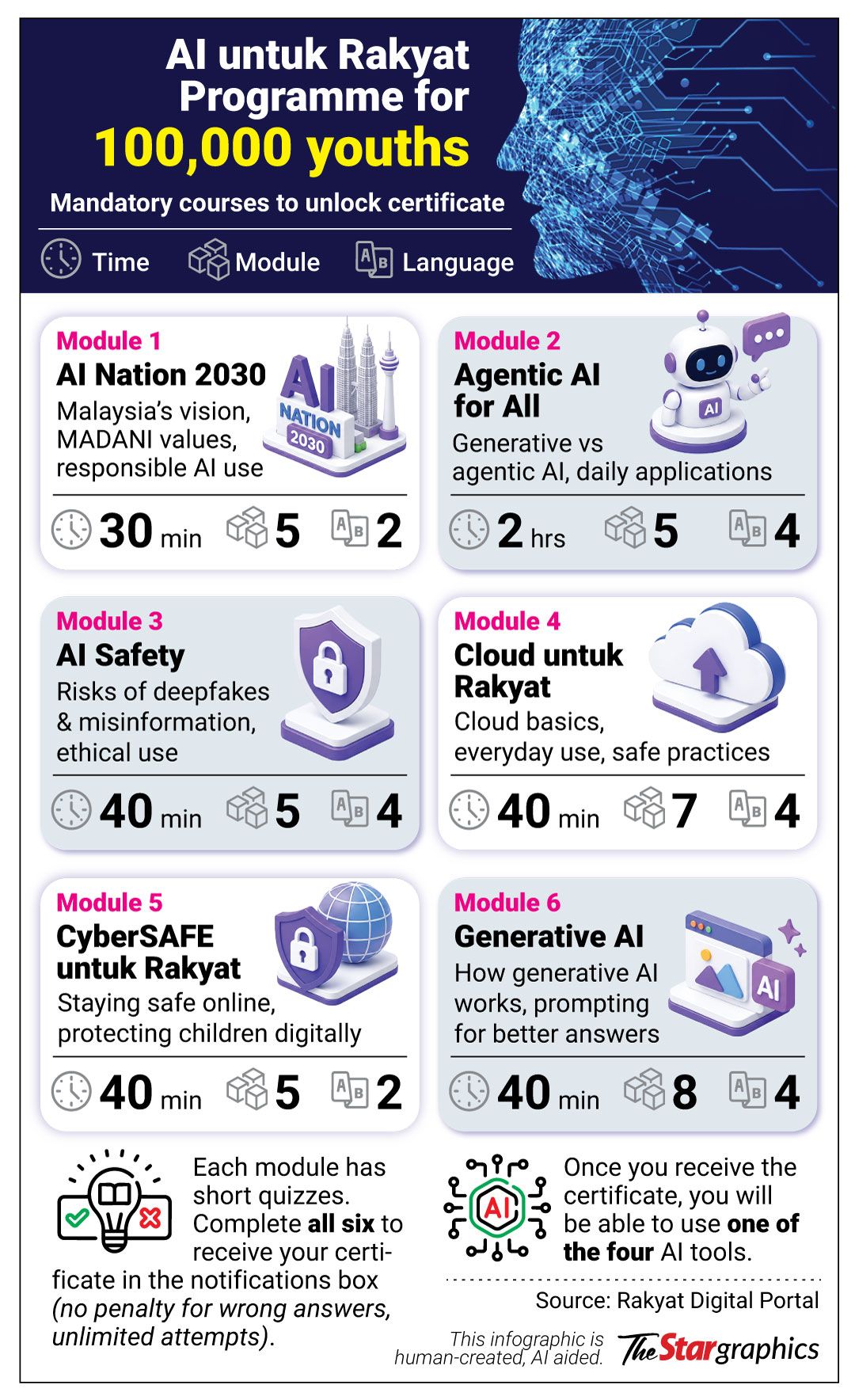
Free AI skills for 100,000 youths - AI COURDES

CLICK TO ENLARGE

PETALING JAYA: Some 100,000 Malaysian youths will have the opportunity to strengthen their digital skills and gain hands-on artificial intelligence (AI) experience under the government’s AI Untuk Rakyat programme.

Upon completing six self-paced modules, participants can access premium AI tools for academic work, creative projects and ­professional tasks, including Google’s Gemini, YTL’s ILMUChat, Alibaba Cloud’s MuleRun and WonderClip.

The modules have no time limit, but participants must complete each subsection before progressing.

Explanations are in simple English and Bahasa Malaysia.

To begin, applicants must log into the Rakyat Digital portal by scanning a QR code with their MyDigital ID, then access the six courses through the dashboard.

The first module outlines Malay­sia’s AI goals, linking the programme to the government’s economic framework to “raise the ceiling” by growing national wealth and “raise the floor” by improving living standards.

It also explains how AI should benefit Malaysians while streng­thening the country’s AI capabi­lities.

The module outlines six govern­ment core values – sustainability, prosperity, compassion, trust, respect and innovation – and how they apply to AI.

Participants are reminded that AI should be used responsibly, shared fairly and developed to benefit people and the environment.

The second module introduces youths to agentic AI systems that can take initiative instead of ­waiting for user prompts.

Learners explore its history, mechanics and applications through exercises using Copilot and ChatGPT.

The portal said the course demonstrates how agentic AI can handle everyday tasks, helping users direct technology to work for them.

The third module focuses on building trustworthy AI, stressing fairness, transparency, accoun­tability, privacy and human- centric design.

Learners explore positive and negative applications of deepfakes and why the challenge lies not in the technology itself, but in how it is used.

Local case studies show how the lessons can be applied.

The fourth module introduces cloud computing, allowing users to store data, run applications and access computing resources without expensive hardware.

“There are three common core cloud services which are Infra­structure as a Service (IaaS), Platform as a Service (PaaS) and Software as a Service (SaaS).

“Each offers unique benefits tailored to different organisa­tional needs,” the portal said.

The fifth module – CyberSAFE untuk Rakyat – covers cyber­security and personal data protection, ­explai­ning threats such as ­malware, phishing and ransomware.

It highlights antivirus software, strong passwords, multi- factor authentication as well as regular updates.

It also explains the regulatory framework under personal data protection laws, including child­ren’s online safety, open communication, parental controls and active supervision.

The final module traces AI’s evolution from systems that ­analyse data to generative AI that creates text, images and music.

“Learners are introduced to prompting techniques, the advantages and challenges of gene­rative AI and key buzzwords such as natural language processing (NLP) and large language models (LLMs).

“The aim is to give participants both conceptual understanding and practical skills to engage confidently with modern AI tools,” the portal said.

After completing the modules, participants can redeem one of the four AI tools free for three months.

In a statement on Aug 30, the Digital Ministry said the initiative would give youths opportunities to explore advanced technology, enhance creativity, productivity and digital skills, and build ­confidence in using emerging technologies responsibly.

“This is in line with Malaysia’s aspiration to develop an inclusive AI Nation by 2030, aligned with the Malaysia Digital 2030 aspirations,” it said.

The programme was anno­unced by Prime Minister Datuk Seri Anwar Ibrahim during the 2026 National Day Premier Address at the Putrajaya Inter­national Convention Centre on Aug 30.

NOTES:

To log in to the Rakyat Digital portal and access your courses, follow these sequential steps:
  1. Open the Rakyat Digital portal on your computer or tablet web browser.
  2. Select the MyDigital ID login option on the main sign-in page to display the unique QR code.
  3. Open the MyDigital ID app on your smartphone.
  4. Tap the QR scanner icon within the app interface.
  5. Scan the QR code displayed on your computer screen using your phone's camera.
  6. Authenticate the request on your phone by entering your PIN or using biometrics (fingerprint/face recognition).
  7. Navigate the dashboard on your computer screen once the portal redirects you.
  8. Click on the courses section to view and start your six enrolled courses.
Are you experiencing any specific error messages while scanning, or do you need help navigating the dashboard once you are logged in?
A modern, accessible learning platform for digital skills.
Missing: .open