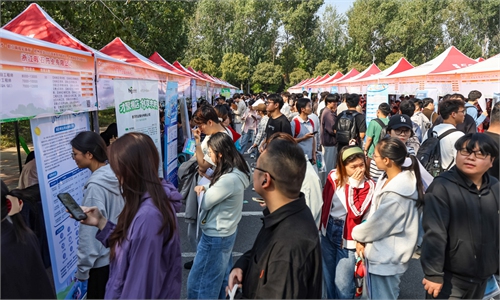
Staff members conduct data collection for various scenarios at a company’s embodied?AI robot data collection and training center in Suqian, East China’s Jiangsu Province on September 3, 2026. Through real-robot simulation, on-site operations, and human-robot collaboration, the center precisely captures multi-dimensional core data such as vision, motion, and environment data, laying a solid data foundation for the optimization and iteration of embodied-AI models. Photo: VCG
China has rolled out a set of policy measures to create more jobs through artificial intelligence (AI), improve employment quality and mitigate the impact of job displacement resulting from AI applications, helping build an employment-friendly development model, amid the rapid development and growing use of the technology.
The guidelines, issued by the General Office of the State Council and made public on Friday, outline 18 major tasks across six areas, covering AI-driven job creation, employment-friendly AI adoption, workforce training, employment services, labor rights and social security protections, and employment risk monitoring and response.
The document aims to strengthen AI's positive role in creating job opportunities, enhancing traditional jobs through AI, improving employment quality and stimulating entrepreneurship, while mitigating the impact of AI-related job displacement, according to the guidelines.
It also seeks to promote inclusive development by ensuring that technological progress and industrial upgrading go hand in hand with employment growth and improvements in people's livelihoods.
To strengthen AI's job creation potential, the guidelines call for expanding employment opportunities in emerging sectors, helping micro, small and medium-sized enterprises retain and expand their workforce, developing new AI-related employment and entrepreneurship models, and accelerating the development of new AI-related occupations.
The document also calls for building an employment-friendly pathway for AI adoption, including tapping the employment potential of AI in traditional industries, easing job displacement pressures arising from AI applications and establishing mechanisms to assess employment risks associated with the technology.
To improve workers' digital literacy and employability, the guidelines call for coordinated efforts to develop innovative AI talent and the implementation of dedicated AI training programs.
In terms of employment services, the document calls for using AI to facilitate the implementation of employment policies, improve the intelligence and efficiency of employment services, and strengthen support for workers transitioning to new jobs or occupations.
The guidelines also emphasize improving labor rights and social security systems to keep pace with technological changes. Measures include improving labor rights protections to accommodate human-AI collaboration, improving social security arrangements for flexible workers and those in new forms of employment, and refining income distribution mechanisms to adapt to AI development.
To address potential employment risks arising from AI applications, the document proposes strengthening employment risk monitoring and early-warning systems related to AI applications, stepping up research into AI's impact on employment, and improving mechanisms to respond to emerging employment risks.
The guidelines call on local governments and relevant departments to implement the measures in accordance with local conditions. Human resources and social security authorities and development and reform departments at all levels are also urged to strengthen coordination to ensure the measures are effectively implemented.
The latest guidelines are in line with a five-year plan for implementing the employment-firs initiative, fostering more entrepreneurial projects involving innovative AI applications andt strategy released by the State Council in June, which called for advancing the "AI Plus" the commercialization of technological achievements, exploring new forms of work involving human-AI collaboration, and strengthening AI's role in job creation.
Source link : https://www.globaltimes.cn/page/202610/1372863.shtml
Gates, the Microsoft co-founder, said he saw three main risks arising from the fast deployment of AI. — AFP
WASHINGTON: Bill Gates warned on Aug 26 that the world is dangerously unprepared for the upheaval brought by artificial intelligence (AI), with the technology destroying jobs and threatening human connection, especially for young people.
In a nearly 6,000-word essay published on his blog, the Microsoft co-founder said the shift into the AI era will rank among the most turbulent periods in human history and that no one has produced a credible plan for managing it.
His stance will draw significant pushback from many in Silicon Valley and the Trump administration who blame "doomer" attitudes among some tech leaders for giving the AI revolution a bad reputation.
"AI will either be the greatest equaliser ever invented, or the worst source of injustice," wrote Gates, 70, who now chairs the philanthropic foundation that bears his name.
"There is no plan to ease the entry into the AI era," Gates said, adding that he would likely support one if it existed.
"However, I don't think that's going to happen. The geopolitical and economic incentives are pushing too hard to go full speed ahead," he warned.
Gates said he saw three main risks arising from the fast deployment of AI.
The first is permanent job destruction. Gates insisted comparisons to the shift from farm work to office work were misleading, as that transition unfolded over generations and created roles that still required human thinking.
AI can substitute for thinking itself, he warned, hitting law, medicine, customer service, software and manufacturing within roughly a decade.
Entry- and mid-level positions are the most exposed, Gates said, leaving young people entering a labour market with far fewer openings.
Blue-collar work will follow as robots become cheaper, with the construction and hospitality sectors feeling pressure by the end of the decade.
Gates suggested that some jobs should be set aside for humans, even if AI can do them better and more cheaply.
The second risk is that AI hands new capabilities to bad actors.
Gates said cybersecurity specialists he knows are alarmed that attackers are gaining ground faster than defenders can patch weaknesses.
Hospitals, banks, water systems and power grids are all exposed, he said.
The third area of risk concerns children and human relationships.
Citing research, Gates said AI chatbots that never challenge or frustrate users risk becoming addictive and denying people the chance to build social skills.
AI bots "rob us of the lessons we learn from connecting with other people," he wrote.
Gates acknowledged he retains deep financial ties to the technology industry, saying investment profits will flow to his foundation, which plans to spend its remaining US$200bil (RM805.4bil) over the next two decades.
The essay comes months after Gates was interviewed by the House Oversight Committee over his ties to the late sex offender Jeffrey Epstein, telling lawmakers in June that the association was "a grave error in judgment."
FILE - John Ternus, Apple's V.P. of Hardware Engineering, discuss the latest development for the iPad Pro during an event to announce new products Tuesday Oct. 30, 2018, in the Brooklyn borough of New York. (AP Photo/Bebeto Matthews, File)
Hardware chief inherits iphone empire, faces China test
SAN FRANCISCO: John Ternus takes over as Apple’s chief executive officer (CEO) effective today, inheriting a company that towers over the smartphone market but trails its rivals in artificial intelligence (AI).
One of his biggest challenges will be balancing the company’s dependence on China while parrying acute political pressure from the White House.
The handover ends Tim Cook’s 15-year run, replacing the operations specialist who built Apple’s supply chain with the engineer who built its hardware.
Ternus, 51, joined Apple’s design team in 2001 and worked his way up to senior vice president of hardware engineering, reporting to Cook.
He leads the engineering teams behind Apple’s entire product lineup, including the iPhones that generate most of the company’s revenue.
He gets barely a week to settle in, with Apple holding its annual iPhone event on Sept 9, where it is expected to unveil its first foldable handset.
“Tim Cook left the house in phenomenal order,” said Dan Ives, partner and senior managing director at investment firm Yorkville Ives & Co. “But now it’s about Ternus defining the AI chapter.”
Ives expects the new CEO to lean into what he knows.
“There’s no reason to fix what’s already working,” he said, predicting Ternus will concentrate on hardware innovation while leaving Cook’s supply chain intact.
Some analysts had argued software chief Craig Federighi was the more logical pick for a company scrambling to catch up on AI.
Carolina Milanesi, an analyst at Creative Strategies, said that misreads how consumers actually adopt technology.
“Consumers are still buying hardware first, and it’s going to be like that for a long time,” she said.
“You’re not going to discover the value of AI if you’re not interested in the hardware.”
Ternus earned a bachelor’s degree in mechanical engineering from the University of Pennsylvania and worked as an engineer at Virtual Research Systems before joining Apple.
Inside the company he is credited with driving a push to make products more durable, reliable and resilient, and with design work that cut carbon footprint.
The harder question is what kind of leader he becomes.
“Even people that know him now don’t know him as a CEO,” Milanesi said.
“You might know him as the head of engineering, but once you’re CEO, things change. Your responsibility is bigger, your power is bigger. You’re dancing a different kind of dance.”
Nowhere is that gap wider than in the geopolitical role Cook excelled at, courting both Beijing and Donald Trump’s White House to protect a supply chain that runs largely through China.
Apple’s manufacturing operation is among the most complex in corporate history, a web of hundreds of suppliers and assembly lines that Cook painstakingly built over decades.
Cook in recent years began shifting some of the work elsewhere – iPhone assembly to India, other production to Vietnam – but the diversification has been gradual with China, one of Apple’s biggest consumer markets, still anchoring the system.
Complicating matters, Trump has repeatedly demanded Apple build iPhones on American soil, threatening tariffs on those made overseas. Cook avoided the heaviest blows of Trump’s trade war by cultivating the president directly, making US investment commitments and political donations – all while also keeping Beijing onside.
The tricky political terrain will be new for Ternus. — AFP
Study shows these ai-powered virtual assistants dish out a significant amount of inaccurate medical information.
A
SUBSTANTIAL amount of medical information provided by five popular
chatbots is inaccurate and incomplete, with half of the answers to clear
evidence based questions “somewhat” or “highly” problematic, show the
results of a study published in the open access journal BMJ Open.
Continued
deployment of these chatbots without public education and oversight
risks amplifying misinformation, warn the researchers.
Generative
artificial intelligence (AI) chatbots have been rapidly adopted across
research, education, business, marketing and medicine, with many people
using them like search engines, including for everyday health and
medical queries, explain the researchers.
To gauge the level of
accuracy provided in areas of health and medicine already prone to
misinformation, and therefore with consequences for everyday health
behaviour, the researchers probed five publicly available and popular
generative AI chatbots in February 2025: Gemini (Google); Deepseek
(High-flyer); Meta AI (Meta); CHATGPT (Openai); and Grok (XAI).
Each
chatbot was prompted with 10 open ended and closed questions in each of
five categories of cancer, vaccines, stem cells, nutrition and athletic
performance.
The prompts were designed to resemble common
“information-seeking” health and medical queries and misinformation
tropes online and in academic discourse.
And they were developed
to “strain” models towards misinformation or contraindicated advice – a
strategy increasingly used for stress testing AI chatbots and picking up
behavioural vulnerabilities, note the researchers.
Closed prompts
required chatbots to provide pre-defined responses, often with one
correct answer, that aligned with the scientific consensus.
Open ended prompts typically required chatbots to generate multiple responses in list form.
Responses were categorised as non-, somewhat, or highly problematic, using objective pre-defined criteria.
A
problematic response was defined as one that could plausibly direct lay
users to potentially ineffective treatment or come to harm if followed
without professional guidance.
The information was scored for
accuracy and completeness, and particular attention was given to whether
a chatbot presented a false balance between science and non-science
based claims, regardless of the strength of the evidence.
Each
response was also graded on readability, ranging from whether it was
written in easy, plain English, to difficult, academic language, using
the Flesch Reading Ease score.
Half (50%) the responses were problematic: 30% were somewhat, and 20% were highly problematic.
Prompt
type was influential: open ended prompts, for example, produced 40
highly problematic responses – significantly more than expected – and 51
non-problematic responses – significantly fewer than expected.
The opposite was true of closed prompts.
While
the quality of responses didn’t differ significantly among the five
chatbots, Grok generated significantly more highly problematic responses
than would be expected (29/50; 58%).
Gemini generated the fewest highly problematic responses and the most non-problematic ones.
The
chatbots performed best intheareaofvaccinesand cancer, and worst in the
area of stem cells, athletic perforaccess mance and nutrition.
Answers were consistently expressed with confidence and certainty, with few caveats or disclaimers.
Out
of the total 250 questions, there were only two refusals to answer,
both of which came from Meta AI in response to queries about anabolic
steroids and alternative cancer treatments.
Reference quality was poor, with an average completeness score of 40%.
Chatbot hallucinations and fabricated citations meant that no chatbot provided a fully accurate reference list.
All readability scores were graded as difficult, equivalent in complexity to suitability for a college graduate.
The
researchers acknowledge that they only assessed five chatbots and that
commercial AI is rapidly evolving, so their findings might not be
universally applicable.
And not all real-world queries are
deliberately adversarial, an approach they took which may have
overstated the prevalence of problematic content.
Nevertheless,
“Our findings regarding scientific accuracy, reference quality and
response readability highlight important behavioural limitations and the
need to re-evaluate how AI chatbots are deployed in public-facing
health and medical communication,” they point out. “By default, chatbots
do not real-time data but instead generate outputs by inferring
statistical patterns from their training data and predicting likely word
sequences.
“They do not reason or weigh evidence, nor are they
able to make ethical or value-based judgements,” they explain. “This
behavioural limitation means that chatcan bots reproduce
authoritative-sounding but potentially flawed responses.”
The data
chatbots draw on also includes Q&A forums and social media, and
scientific content is typically limited to open access or publicly
available articles, which comprise only 30-50% of published studies.
While
this enhances conversational fluency, it may come at the cost of
scientific accuracy, advise the researchers. “As the use of AI chatbots
continues to expand, our data highlight a need for public education,
professional training and regulatory oversight to ensure that generative
AI supports, rather than erodes, public health,” they conclude.
A major risk to the deployment of chatbots without public education and oversight is that they could amplify misinformation, the BMJ Open study ...Read more
Researchers from the US, Canada and the UK evaluated five popular platforms – ChatGPT, Gemini, Meta AI, Grok and DeepSeek – by asking each of them 10 questions across five health categories. — Bloomberg
Artificial intelligence-driven chatbots are giving users problematic medical advice about half the time, according to a new study, highlighting the health risks of the technology that’s becoming increasingly integral in day-to-day life.
Researchers from the US, Canada and the UK evaluated five popular platforms – ChatGPT, Gemini, Meta AI, Grok and DeepSeek – by asking each of them 10 questions across five health categories. Out of the total responses, about 50% were deemed problematic, including almost 20% that were highly problematic, according to findings published this week in medical journal BMJ Open.
The chatbots performed relatively better on closed-ended prompts and questions related to vaccines and cancer, and worse on open-ended prompts and in areas like stem cells and nutrition, according to the study.
Answers were often delivered with confidence and certainty, though no chatbot produced a fully complete and accurate reference list in response to any prompt, the researchers said. There were only two refusals to answer a question, both from Meta AI.
The results highlight the growing concern about how people are using generative AI platforms, which aren’t licensed to give medical advice and lack the clinical judgment to make diagnoses.
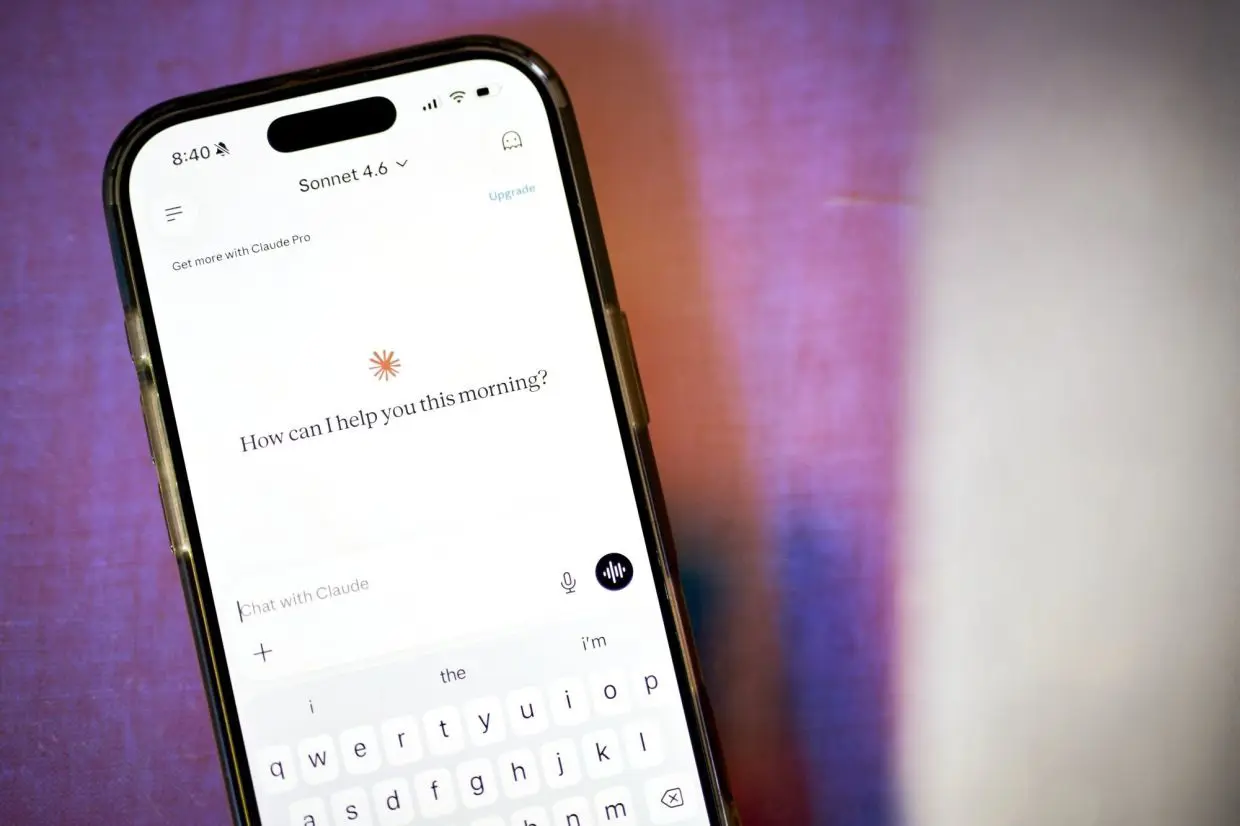
The explosive growth of AI chatbots has made them a popular tool for people seeking guidance on their ailments and OpenAI has said that more than 200 million people ask ChatGPT health and wellness questions every week. The platform announced in January health tools for both everyday users and clinicians, and Anthropic said the same month its Claude product is launching a new health care offering.
A major risk to the deployment of chatbots without public education and oversight is that they could amplify misinformation, the BMJ Open study authors said.
The findings "highlight important behavioral limitations and the need to reevaluate how AI chatbots are deployed in public-facing health and medical communication,” they wrote. These systems can generate "authoritative-sounding but potentially flawed responses,” they wrote. – Bloomberg
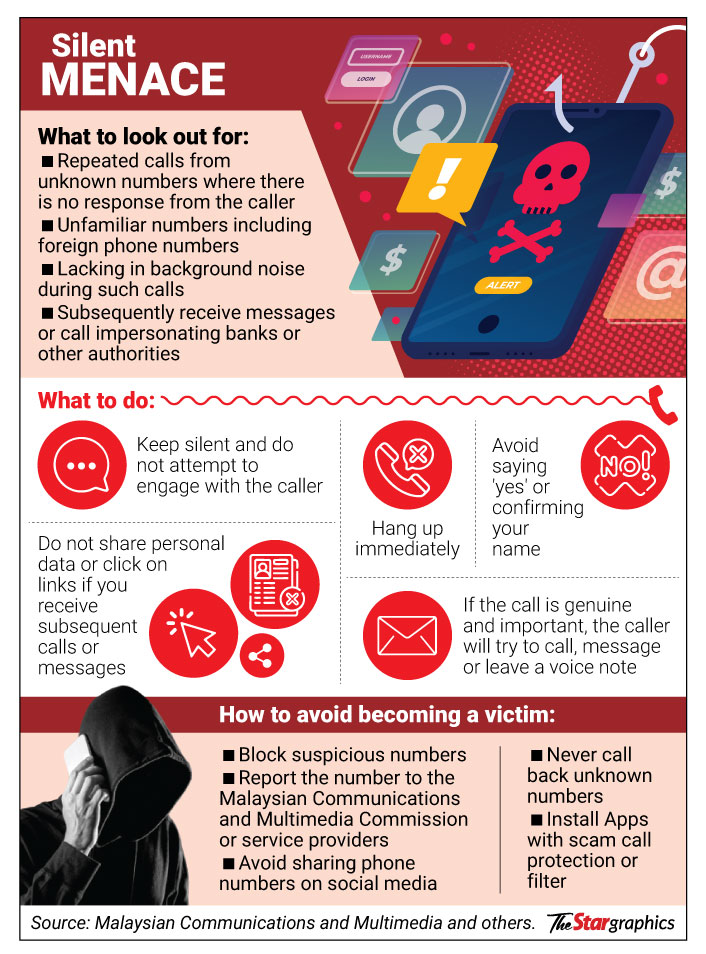
PETALING JAYA: Silence is golden. This is exactly what one should do to avoid becoming a victim of the latest AI-generated silent call scam, says the Malaysian Communications and Multimedia Commission (MCMC).
A recent video released by Friends of MCMC warning of the latest tactic used by scammers saw several Malaysians coming forward to relate their personal experiences.
Sean Ang, 34, a data analyst from Kuala Lumpur, said he grew suspicious of phone calls from unknown numbers recently.
“If I get such calls, I remain silent to see if there is any response before hanging up,” he said.
Magawun is concerned that senior citizens may fall prey to such scams as they are not aware of evolving online threats, particularly those using AI technology.
The silent call is a tactic used by scammers to phish for victims. It begins with ringing up the target, but the caller deliberately leaves the line silent when the call is answered.
By answering, a person is deemed to have an active number and is placed on a target list for scam messages or calls impersonating banks or other authorities.
If the target answers, his voice is recorded and later cloned with AI for impersonation purposes.
The MCMC had recently posted a two-minute video on social media to warn Malaysians that AI technology is being used to gather sound metadata to clone voices.
The AI-cloned voice is then used to scam the target’s family by requesting help due to an emergency, to get a company staff member to transfer money or to by-pass voice verification used by certain commercial institutions.
Mohamed Hussain Rasool Mohd became more alert after reading a warning posted on the Penang Community Facebook page of such modus operandi.
Kaizen Sun, in a posting in the same Facebook page, said those who answered a silent call would usually get follow-up calls the very same day and for the next several days.
“All sorts of numbers – local, mobile and international.
“There was even one WhatsApp text message telling me that he was my long-lost contact from wine trading (and I’m wondering in which lifetime was I involved in the alcohol business),” the post read.